

VOICES

“I know who I am. Always have. My voice was never missing—I was taught to make it smaller.”
— SherriAnne Leslie, Voices
SherriAnne Leslie
I know who I am. Always have.
That may sound like an odd beginning for an essay about the voices we carry. We’re so often told that the work of getting older is to find our voice, as though it were misplaced somewhere between the laundry, the children, the marriage, and the bills.
Mine wasn’t missing. I learned to suppress it.
And I suspect I have plenty of company.
I stumbled across a quote recently suggesting that the voices in our heads aren’t always ours. They’re recordings: parents, teachers, people we loved, people who hurt us. I understood the sentiment immediately. But I wanted to push it further. What if you knew your own voice all along? What if you spoke, clearly and lovingly, and the lesson you kept receiving was that peace mattered more than being heard?
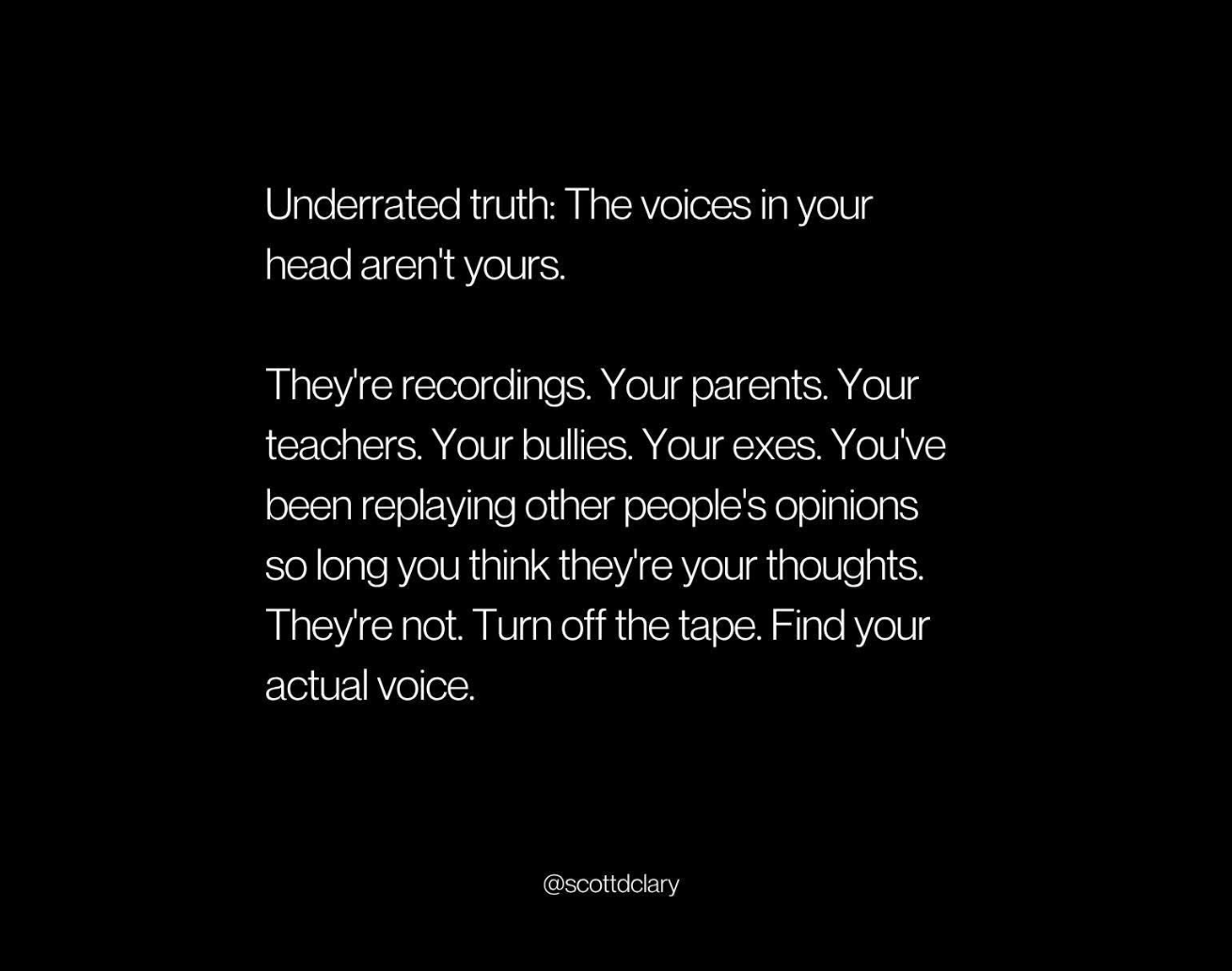
The social-media post that sparked this reflection. Originally shared by @scottdclary.
I was born into a world already crowded with instructions for women. Be kind. Be attractive. Be capable. Don’t make a fuss. Make the marriage work. Keep the family together. My father once told me I could have almost anything in life because I was smart and pretty. I believe he meant to encourage me. Still, isn’t it telling which word lingered? Pretty. A girl growing up in the 1970s and 1980s didn’t need a lecture on her worth to absorb the message. It was everywhere.
Not every voice that shapes us is cruel. Sometimes the words are affectionate. Sometimes the people speaking them love us fiercely. That doesn’t prevent their assumptions from taking root.
I think about the young woman I was in the early 1990s. Smitten. Committed. Convinced that loving someone meant finding a way through whatever life threw at us.
There were eight years of military life, years in Virginia far from the people and places that had grounded me, two miscarriages, a deployment to Iraq, a newborn, a house on the market, and orders that sent us on to Texas. I knew much of it was chaotic and painful while it was happening. I was not blind. I was committed—to him, to us, to our little family. That mattered to both of us, even if we brought profoundly different upbringings and expectations into our marriage.
Military life was followed by corporate hierarchies, pressures, and a relentless succession of transfers and relocations—Vermont, Indiana, Pennsylvania, Ohio. Four states in just 26 months. Two homes built with the promise that each would be our forever home, only to be sold within a year. By the time my eldest was entering sixth grade, he'd lived in six different states.
And none of that happened without my objections. I pleaded for stability, for roots, for the chance to give our children something lasting. Yet somehow, we kept packing up our lives and starting over.
Need I say more?

Four states in 26 months. Numerous promised forever homes. Sometimes keeping a family together meant repeatedly leaving pieces of our lives behind.
And when conflict arose in my marriage, I tried to explain. Calmly. Lovingly. Again and again. I wanted to be understood, not to win a debate. But some conversations became contests, and I kept walking away with the same assignment: find another way to make this work.
Keep the peace. Keep the commitments. Keep the family afloat.
Within the boundaries of what I believed was right, I would try just about anything. Not because I thought every disagreement was my fault. Because I had absorbed the idea that keeping a family together was ultimately my responsibility.
There is a difference between knowing something hurts and having language for the pattern. Today we can talk about emotional labor, coercive dynamics, attachment, codependency, and the ways power can show up inside ordinary conversations. Those terms do not automatically explain a marriage, and they are not diagnoses to throw at people we no longer love. But language can help us ask better questions. Back then, I often had the pain without the vocabulary.
The research suggests that the unequal expectations were never mine alone. In a 2023 Pew Research Center survey of opposite-sex couples raising children, mothers were far more likely than fathers to say they carried the greater share of managing children’s schedules and providing emotional support. The International Labour Organization estimated that 708 million women worldwide were outside the paid labor force in 2023 because of unpaid care responsibilities. Neither figure proves what happened in my home. Both help explain why so many women have been taught to see family maintenance as their job.
And the women of Generation X occupied a peculiar stretch of history. We grew up hearing that we could do anything while still inheriting expectations about what a good wife, a good mother, a good woman should endure. We were promised new possibilities without necessarily being relieved of old responsibilities. We were expected to be independent—and to hold everything together.
But I refuse to tell this story as though I were only the recipient of other people’s words.
I became a voice in other people’s lives, too.
I have said things I regret. I made choices I would make differently. By the time illness began affecting my body in 2005, amid an accident and the unraveling of a marriage, I was trying to function inside circumstances I did not fully understand. I did not yet know the name dystonia for what was happening to me. I know now that there were things I misunderstood about myself, about relationships, and about what my children needed.
My children paid a price for some of what the adults around them did not know, did not recognize, and did not handle well. I can say that much. Their private experiences are theirs to tell, not mine to publish.
That is not an escape from responsibility. It is part of taking responsibility.
I can acknowledge my mistakes without agreeing that every accusation made against me was true. I can recognize harm in a relationship without declaring one person entirely good and the other entirely bad. I can understand that two people may genuinely want a family and still be terribly mismatched in marriage and parenthood.
And I can ask the question that matters most now: What did I pass along before I understood what I was carrying?
That question is not reserved for divorced mothers. It belongs to fathers, grandparents, adult children, teachers, partners—anyone whose voice has become part of somebody else’s inner life. But I especially want to speak to the woman who entered marriage believing love would be enough, the mother still trying to keep everyone afloat, and the older woman looking back at the wreckage and wondering how to tell the truth without hurting the people she loves again.
Sometimes they are not three women. Sometimes they are one woman at three stages of her life.
There is research on divorce, on unequal caregiving, on family estrangement and reconnection. It gives us context, not a verdict on any individual family. It cannot tell us whose memory is correct in a particular argument, who owes whom forgiveness, or whether reconciliation will happen. Those are human questions, and they deserve humility.
What the research can do is remind us that these experiences do not unfold in a vacuum. Our private lives are shaped by public expectations. The things we were taught to accept as normal have consequences that can echo across generations.
Writing has been my oxygen for as long as I could hold a pencil. Since March 2020, it has also been a life raft. Through illness, disability, recovery work, and the painful reexamination of relationships, I have become determined to identify patterns rather than simply relive events. Not to excuse myself. Not to prosecute somebody else on the page. To understand. To make what I’ve learned useful.
There is a little bound book of poems my birthmother gave me after we met. When I began writing this essay, the title of one of those poems came back to me. I haven’t retrieved the book yet. I want to. There is something fitting about that interruption: a woman who entered the world with one name, grew up with another, and now writes under the name she was born with, thinking about whose words we carry and whose voice we allow ourselves to use.

I cannot rewrite the years behind me. But I can examine them, learn from them, and write what I know—while remembering that other people's stories belong to them.
— SherriAnne Leslie, Voices
I know who I am. Always have.
What I didn’t always know was that keeping the peace and telling the truth are not necessarily the same thing. That love and compatibility are not interchangeable. That commitment cannot make one person responsible for the work of two. That our children may carry stories we cannot fully see from where we stand.
I cannot rewrite the years behind me. I cannot speak for my children. I cannot demand that anyone remember our shared past the way I do.
But I can listen. I can own my part. I can question what I inherited. And I can write what I know, carefully enough to protect what is not mine to tell and plainly enough that someone else might recognize a warning sign sooner than I did.
I am not asking to be excused from my mistakes. I am asking that we examine the whole story.
My voice was never missing.
And I am finished confusing its silence with peace.
Research notes & sources
Pew Research Center (2023), “Gender and Parenting.” Survey of U.S. opposite-sex couples raising children; supports discussion of unequal responsibility for scheduling and emotional support. https://www.pewresearch.org/social-trends/2023/01/24/gender-and-parenting/
International Labour Organization (2024), “Unpaid care work prevents 708 million women from participating in the labour market.” Global 2023 estimate; does not measure marital dynamics or divorce. https://www.ilo.org/resource/news/unpaid-care-work-prevents-708-million-women-participating-labour-market
Pew Research Center (2011), “Comparing Millennials with Gen Xers.” Background on generational family structures; not direct proof of any individual’s gender-role beliefs. https://www.pewresearch.org/social-trends/2011/03/09/ii-comparing-millennials-with-gen-xers/