
Where the Leaves Lead
On a day filled with pain, worry, and endless responsibilities, a blind and deaf rescue dog named Willa and the breathtaking colors of an Ohio autumn reminded me that life doesn't wait for the work to be finished.
By SherriAnne Leslie
Many days, life demands more than my body has to give.
Today has been one of those days.
Three pet care jobs. Business responsibilities that seem to multiply faster than I can check them off. Messages to answer, schedules to coordinate, and a to-do list that doesn't seem to understand the meaning of enough.
And Damien—my name for the cervical dystonia that has occupied my body for more than twenty years—is particularly angry today.
As if that weren't enough, one of my dearest friends, Tink, underwent surgery this morning. I've been carrying worry for her since her most current and concerning health problems began around her birthday a month ago. The kind of worry that settles somewhere beneath your ribs and follows you from one task to the next.
There are days when I wonder how much one person is supposed to carry.
And yet, here I am.
Standing on a beautiful gray wooden deck with white railings, overlooking a brick patio and a backyard that seems to stretch forever.
I'm at Willa's, in Broadview Heights, Ohio.
One of my favorite places in the world.
And October has outdone herself.
A Little White Dog Named Willa
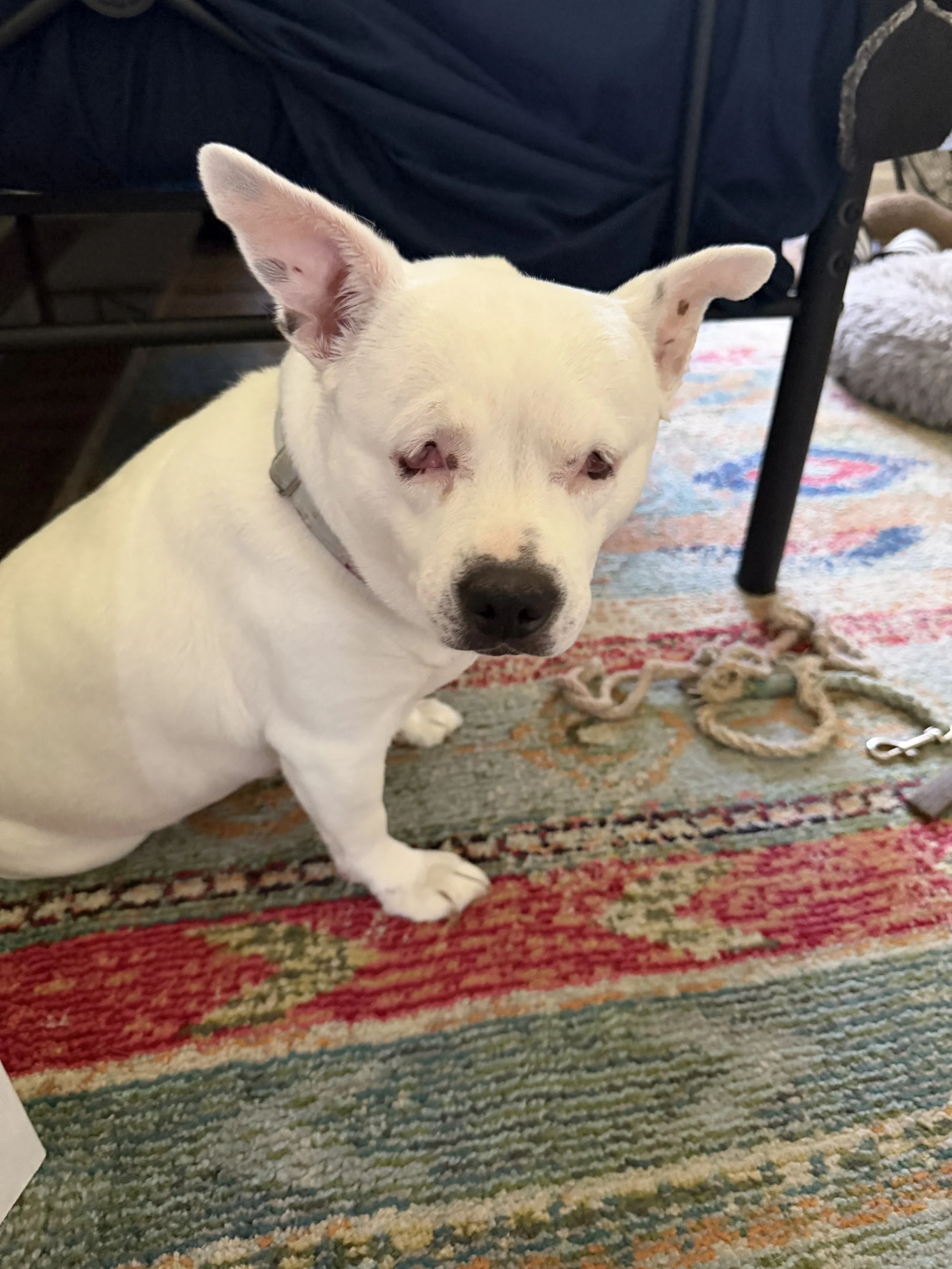
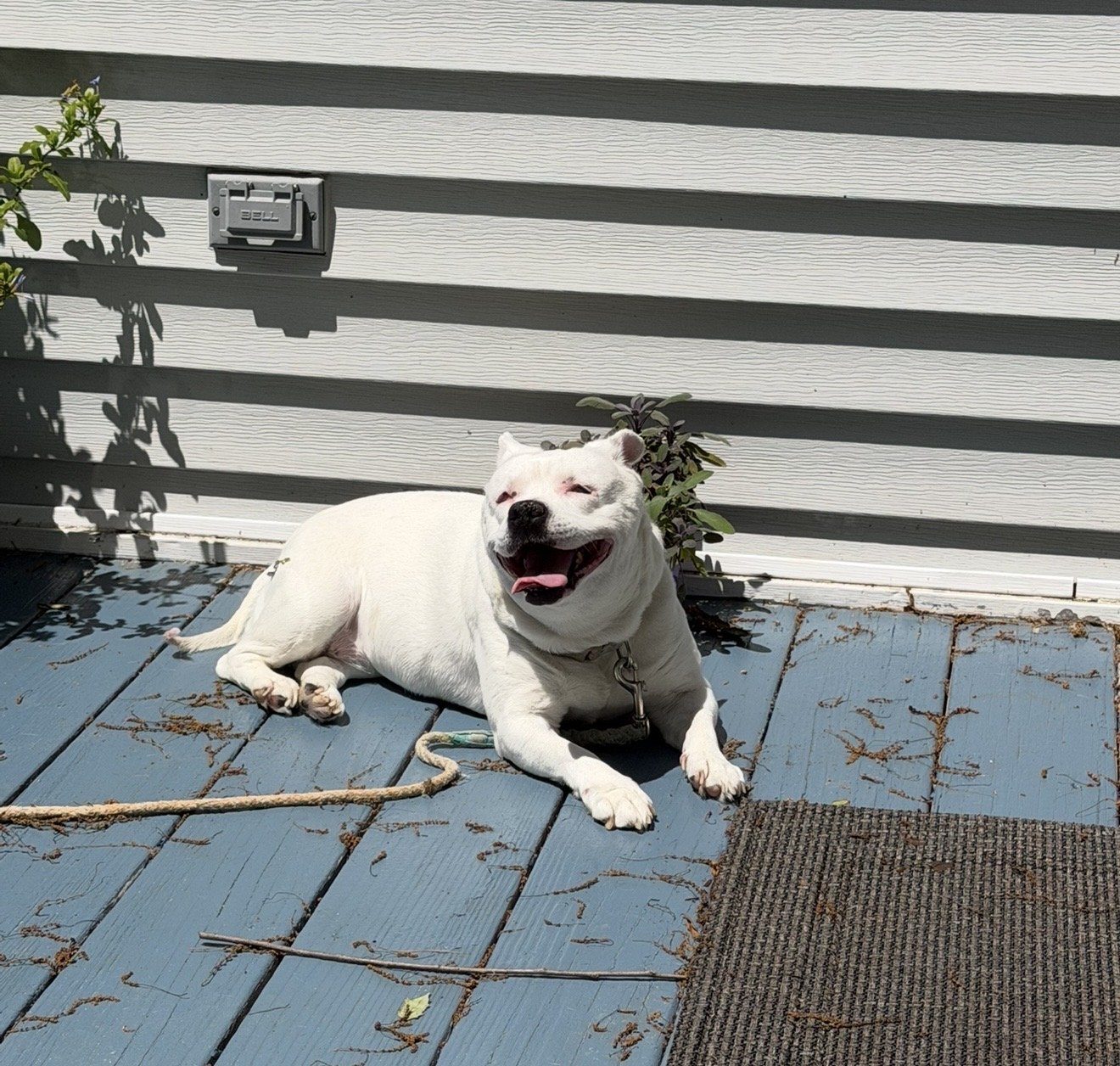
Willa is a rescue dog who is both blind and deaf.
She's a little white sweetheart with wonderfully expressive ears, a dark nose, and a face that can look both utterly serious and completely delighted.
She shares her home with five cats—Moxie, Z, Vera, Bert, and Howie—a collection of personalities that could easily provide enough material for an entire book.
There's always something happening in a household with six animals.
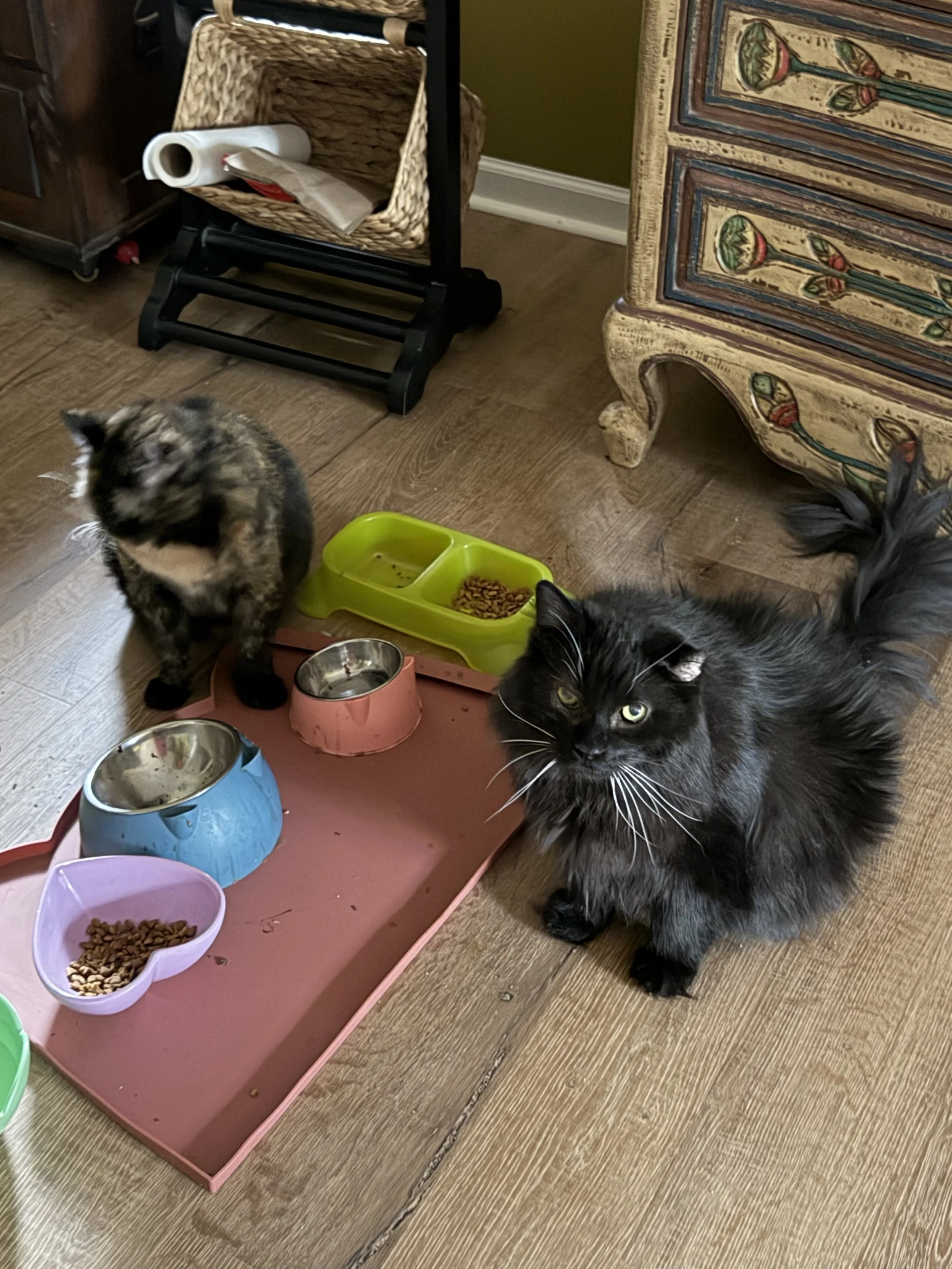
Food bowls to fill. Water to refresh. Litter boxes to tend. Someone waiting for attention. Someone else observing the entire operation with the unmistakable expression of a supervisor who is unimpressed with management.
And then there's Willa.
Willa loves the sunshine.
I've watched her stretch out on the deck, settling into a patch of warmth as though she's discovered the most luxurious accommodations in the world.
Today, she's outside with me.
I find myself thinking about how differently the two of us experience this afternoon.
Willa cannot see the brilliant colors spreading across the trees. She cannot hear the breeze moving through the branches or the leaves stirring overhead.
But she can feel the warmth of the sun.
And I suspect she appreciates it every bit as much as I do.
There is something lovely about sharing a moment without needing to experience it in exactly the same way.
October's Masterpiece
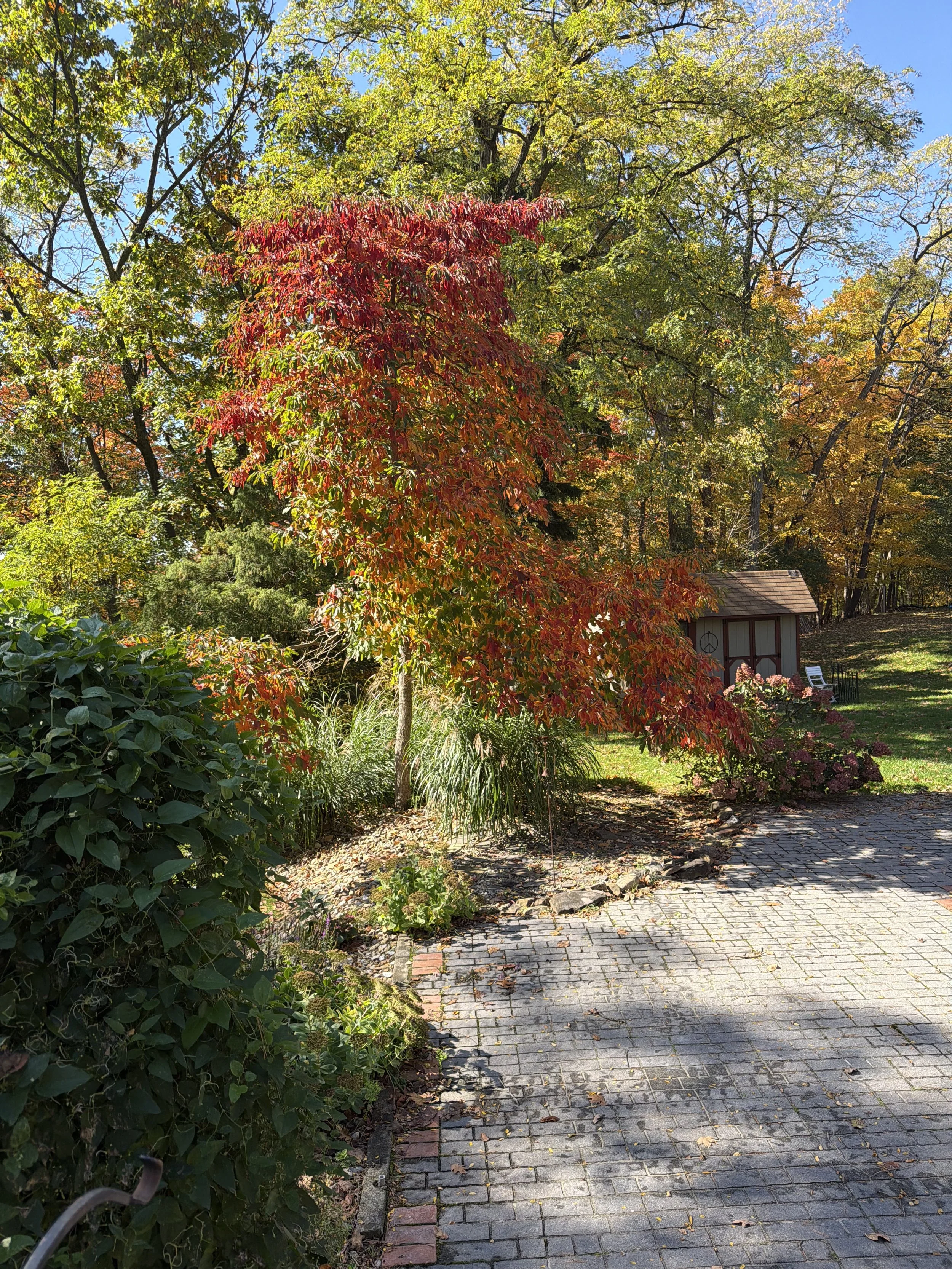
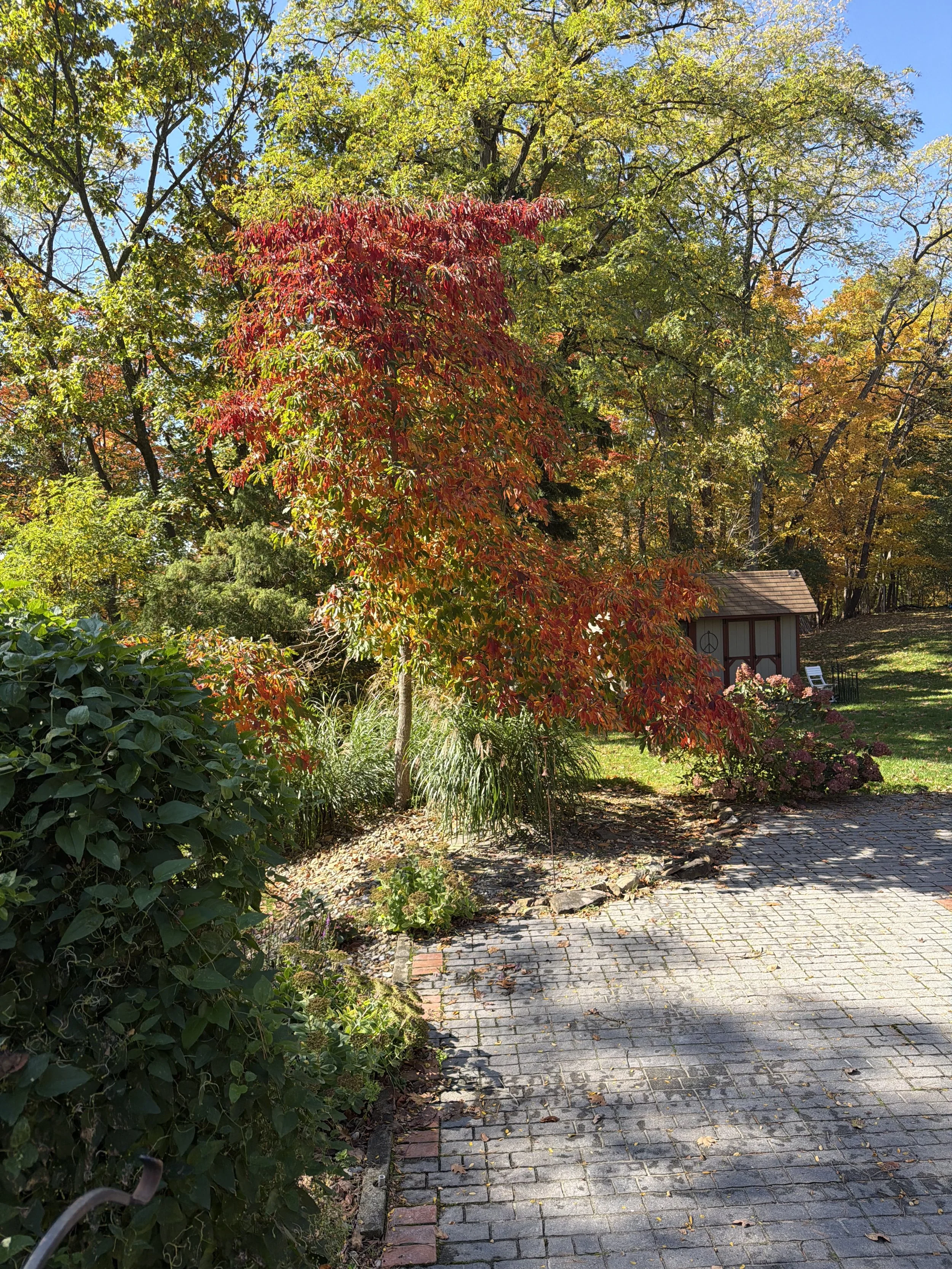
Before me stands a tree that looks almost like a layer cake.
Green. Crimson. Brilliant orange. Yellow.
Its colors are arranged in such a remarkable scatter among the layers that I can't imagine an artist improving upon them.
Behind it, the taller trees have made their own seasonal decisions. Some remain stubbornly green, while others have surrendered to gold, amber, and rust.
Near the deck, hydrangeas have deepened into wine-colored clusters. Pink blossoms linger along the railing, seemingly unaware that autumn has arrived.
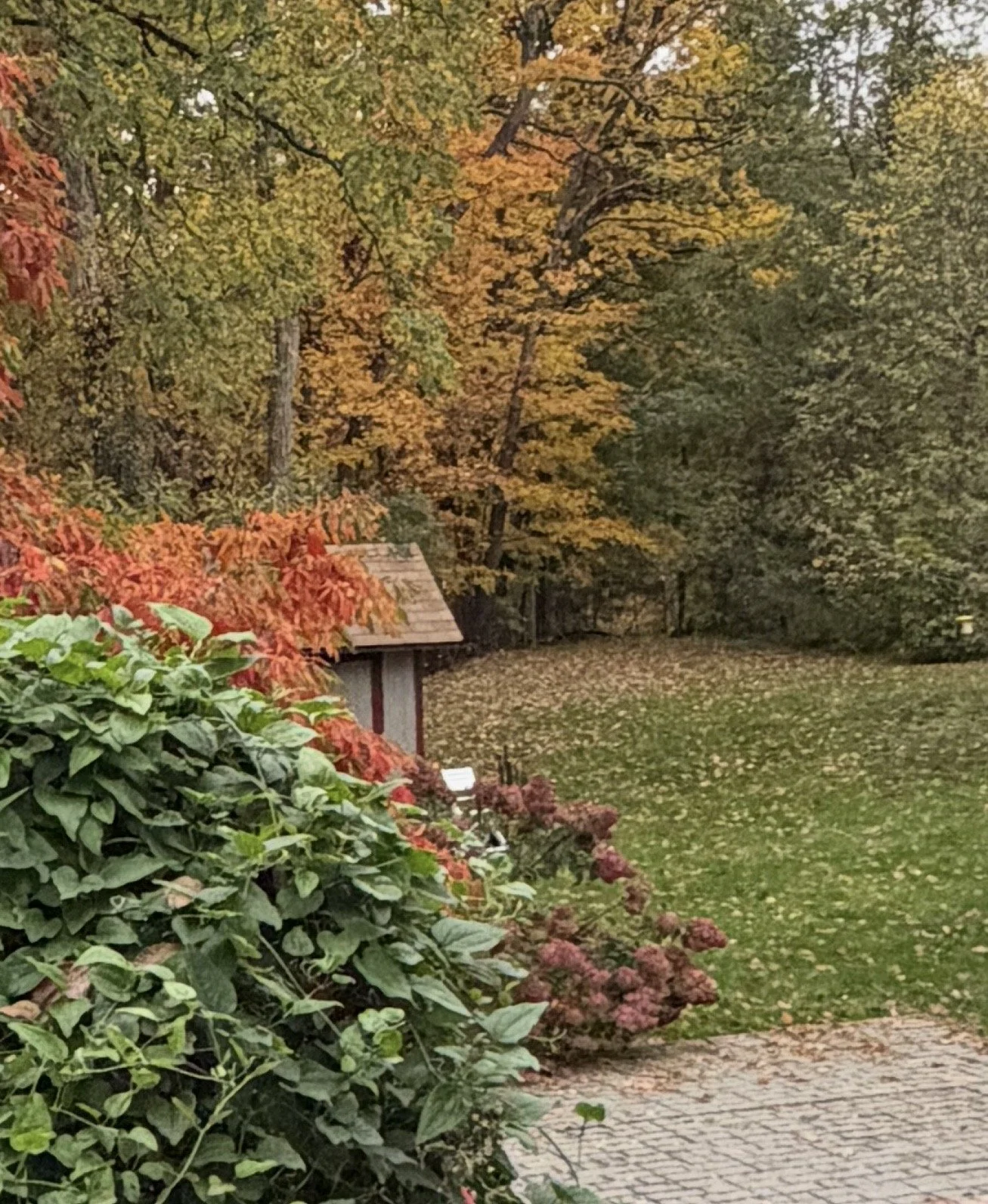
Below, a brick patio opens onto a broad green lawn stretching toward the woods.
And the leaves.
Oh, the leaves.
Near the patio, they're scattered sparingly, as though someone has dropped a handful of confetti.
Farther out, they become more plentiful.
They remind me of rose petals scattered along a bridal path, inviting someone toward something wonderful.
By the time they reach the woods, they practically carpet the ground.
There's a creek nearby. Down the hill, a barn with horses. I've even spotted a fox here before.
It's the sort of place where I can stand still for a moment and discover something I hadn't noticed on my last visit.
And today, I need that.
The Things That Ask Nothing of Me
I take in the colors, but the beauty of this place goes far beyond what I can see.
There's the breeze brushing my skin.
The scent of damp earth and musty fallen leaves.
The cool grass beneath my bare feet.
The warmth of the sunlight finding its way through the clouds.
The sound of the trees moving gently overhead.
And Willa, content in her own little world of sunshine.
For a few moments, nothing here asks me to be more than I am.
No invoices.
No deadlines.
No decisions.
No explanations.
No expectation that I should somehow manage to accomplish eight hours of work in a body that may give me only a fraction of that.
I don't have to be a business owner, a problem solver, or a woman desperately trying to catch up with everything her body won't allow her to finish.
I can simply be here.
I have spent enough years navigating pain, disability, loss, recovery, and uncertainty to recognize that peace isn't always something we achieve after the work is finished.
Sometimes it arrives in the middle of the unfinished work.
Sometimes it comes while someone we love is undergoing surgery, while our bodies are protesting, while our responsibilities are waiting impatiently for our attention.
Sometimes it comes in the company of a little white dog who has no idea how beautiful the leaves are.
And doesn't need to.
Where the Leaves Lead
The difficult things don't disappear because the leaves are beautiful.
Tink is still on my mind.
Damien is still angry.
The business still needs my attention.
Tomorrow's responsibilities aren't going anywhere.
And I know that when I step back inside, there will be cats to check on, bowls to tend, and all the ordinary little responsibilities that come with caring for someone else's beloved animals.
But neither is this moment going anywhere—not if I take the time to recognize it.
I look out across the lawn again.
The scattered leaves lead toward the woods, where the trees stand in every shade of autumn.
Willa is enjoying the sunshine.
And I'm reminded that the life I'm working so hard to build is also the life I'm supposed to be living.
Not someday, when everything is finished.
Not when the crippling pain finally lets up.
Not when every message has been answered and every item on the list has been checked off.
Now.
Right here.
On an October afternoon in Ohio, with a little white dog beside me and a thousand beautiful leaves leading toward the woods.
Today, amid everything demanding my attention, October has offered me something extraordinary.
A reminder that I am still capable of feeling wonder.
And perhaps, for today, the most important thing on my to-do list is remembering to notice it.

VOICES
I know who I am. Always have. But knowing your voice and being free to use it are two very different things.

“I know who I am. Always have. My voice was never missing—I was taught to make it smaller.”
— SherriAnne Leslie, Voices
SherriAnne Leslie
I know who I am. Always have.
That may sound like an odd beginning for an essay about the voices we carry. We’re so often told that the work of getting older is to find our voice, as though it were misplaced somewhere between the laundry, the children, the marriage, and the bills.
Mine wasn’t missing. I learned to suppress it.
And I suspect I have plenty of company.
I stumbled across a quote recently suggesting that the voices in our heads aren’t always ours. They’re recordings: parents, teachers, people we loved, people who hurt us. I understood the sentiment immediately. But I wanted to push it further. What if you knew your own voice all along? What if you spoke, clearly and lovingly, and the lesson you kept receiving was that peace mattered more than being heard?
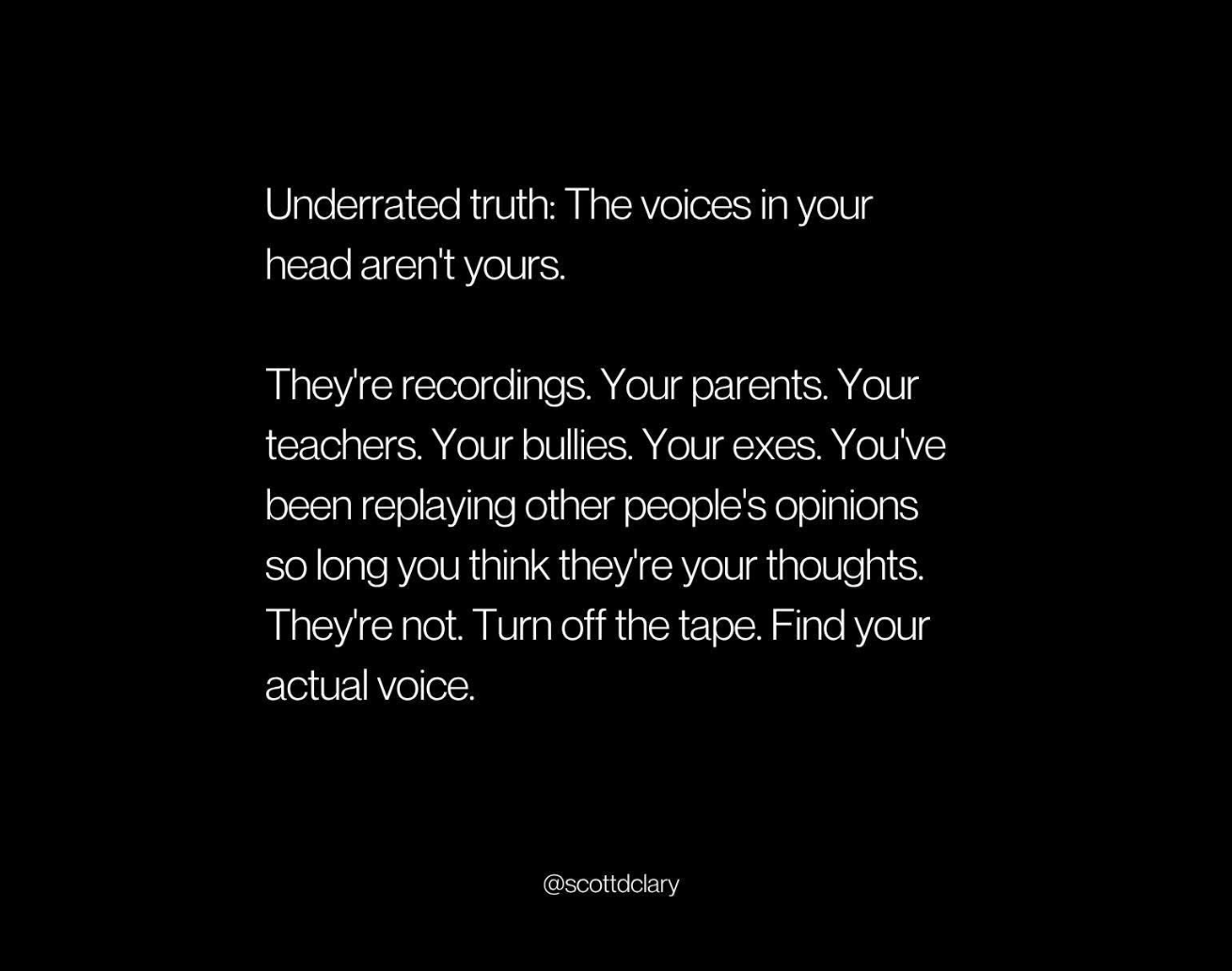
The social-media post that sparked this reflection. Originally shared by @scottdclary.
I was born into a world already crowded with instructions for women. Be kind. Be attractive. Be capable. Don’t make a fuss. Make the marriage work. Keep the family together. My father once told me I could have almost anything in life because I was smart and pretty. I believe he meant to encourage me. Still, isn’t it telling which word lingered? Pretty. A girl growing up in the 1970s and 1980s didn’t need a lecture on her worth to absorb the message. It was everywhere.
Not every voice that shapes us is cruel. Sometimes the words are affectionate. Sometimes the people speaking them love us fiercely. That doesn’t prevent their assumptions from taking root.
I think about the young woman I was in the early 1990s. Smitten. Committed. Convinced that loving someone meant finding a way through whatever life threw at us.
There were eight years of military life, years in Virginia far from the people and places that had grounded me, two miscarriages, a deployment to Iraq, a newborn, a house on the market, and orders that sent us on to Texas. I knew much of it was chaotic and painful while it was happening. I was not blind. I was committed—to him, to us, to our little family. That mattered to both of us, even if we brought profoundly different upbringings and expectations into our marriage.
Military life was followed by corporate hierarchies, pressures, and a relentless succession of transfers and relocations—Vermont, Indiana, Pennsylvania, Ohio. Four states in just 26 months. Two homes built with the promise that each would be our forever home, only to be sold within a year. By the time my eldest was entering sixth grade, he'd lived in six different states.
And none of that happened without my objections. I pleaded for stability, for roots, for the chance to give our children something lasting. Yet somehow, we kept packing up our lives and starting over.
Need I say more?

Four states in 26 months. Numerous promised forever homes. Sometimes keeping a family together meant repeatedly leaving pieces of our lives behind.
And when conflict arose in my marriage, I tried to explain. Calmly. Lovingly. Again and again. I wanted to be understood, not to win a debate. But some conversations became contests, and I kept walking away with the same assignment: find another way to make this work.
Keep the peace. Keep the commitments. Keep the family afloat.
Within the boundaries of what I believed was right, I would try just about anything. Not because I thought every disagreement was my fault. Because I had absorbed the idea that keeping a family together was ultimately my responsibility.
There is a difference between knowing something hurts and having language for the pattern. Today we can talk about emotional labor, coercive dynamics, attachment, codependency, and the ways power can show up inside ordinary conversations. Those terms do not automatically explain a marriage, and they are not diagnoses to throw at people we no longer love. But language can help us ask better questions. Back then, I often had the pain without the vocabulary.
The research suggests that the unequal expectations were never mine alone. In a 2023 Pew Research Center survey of opposite-sex couples raising children, mothers were far more likely than fathers to say they carried the greater share of managing children’s schedules and providing emotional support. The International Labour Organization estimated that 708 million women worldwide were outside the paid labor force in 2023 because of unpaid care responsibilities. Neither figure proves what happened in my home. Both help explain why so many women have been taught to see family maintenance as their job.
And the women of Generation X occupied a peculiar stretch of history. We grew up hearing that we could do anything while still inheriting expectations about what a good wife, a good mother, a good woman should endure. We were promised new possibilities without necessarily being relieved of old responsibilities. We were expected to be independent—and to hold everything together.
But I refuse to tell this story as though I were only the recipient of other people’s words.
I became a voice in other people’s lives, too.
I have said things I regret. I made choices I would make differently. By the time illness began affecting my body in 2005, amid an accident and the unraveling of a marriage, I was trying to function inside circumstances I did not fully understand. I did not yet know the name dystonia for what was happening to me. I know now that there were things I misunderstood about myself, about relationships, and about what my children needed.
My children paid a price for some of what the adults around them did not know, did not recognize, and did not handle well. I can say that much. Their private experiences are theirs to tell, not mine to publish.
That is not an escape from responsibility. It is part of taking responsibility.
I can acknowledge my mistakes without agreeing that every accusation made against me was true. I can recognize harm in a relationship without declaring one person entirely good and the other entirely bad. I can understand that two people may genuinely want a family and still be terribly mismatched in marriage and parenthood.
And I can ask the question that matters most now: What did I pass along before I understood what I was carrying?
That question is not reserved for divorced mothers. It belongs to fathers, grandparents, adult children, teachers, partners—anyone whose voice has become part of somebody else’s inner life. But I especially want to speak to the woman who entered marriage believing love would be enough, the mother still trying to keep everyone afloat, and the older woman looking back at the wreckage and wondering how to tell the truth without hurting the people she loves again.
Sometimes they are not three women. Sometimes they are one woman at three stages of her life.
There is research on divorce, on unequal caregiving, on family estrangement and reconnection. It gives us context, not a verdict on any individual family. It cannot tell us whose memory is correct in a particular argument, who owes whom forgiveness, or whether reconciliation will happen. Those are human questions, and they deserve humility.
What the research can do is remind us that these experiences do not unfold in a vacuum. Our private lives are shaped by public expectations. The things we were taught to accept as normal have consequences that can echo across generations.
Writing has been my oxygen for as long as I could hold a pencil. Since March 2020, it has also been a life raft. Through illness, disability, recovery work, and the painful reexamination of relationships, I have become determined to identify patterns rather than simply relive events. Not to excuse myself. Not to prosecute somebody else on the page. To understand. To make what I’ve learned useful.
There is a little bound book of poems my birthmother gave me after we met. When I began writing this essay, the title of one of those poems came back to me. I haven’t retrieved the book yet. I want to. There is something fitting about that interruption: a woman who entered the world with one name, grew up with another, and now writes under the name she was born with, thinking about whose words we carry and whose voice we allow ourselves to use.

I cannot rewrite the years behind me. But I can examine them, learn from them, and write what I know—while remembering that other people's stories belong to them.
— SherriAnne Leslie, Voices
I know who I am. Always have.
What I didn’t always know was that keeping the peace and telling the truth are not necessarily the same thing. That love and compatibility are not interchangeable. That commitment cannot make one person responsible for the work of two. That our children may carry stories we cannot fully see from where we stand.
I cannot rewrite the years behind me. I cannot speak for my children. I cannot demand that anyone remember our shared past the way I do.
But I can listen. I can own my part. I can question what I inherited. And I can write what I know, carefully enough to protect what is not mine to tell and plainly enough that someone else might recognize a warning sign sooner than I did.
I am not asking to be excused from my mistakes. I am asking that we examine the whole story.
My voice was never missing.
And I am finished confusing its silence with peace.
Research notes & sources
Pew Research Center (2023), “Gender and Parenting.” Survey of U.S. opposite-sex couples raising children; supports discussion of unequal responsibility for scheduling and emotional support. https://www.pewresearch.org/social-trends/2023/01/24/gender-and-parenting/
International Labour Organization (2024), “Unpaid care work prevents 708 million women from participating in the labour market.” Global 2023 estimate; does not measure marital dynamics or divorce. https://www.ilo.org/resource/news/unpaid-care-work-prevents-708-million-women-participating-labour-market
Pew Research Center (2011), “Comparing Millennials with Gen Xers.” Background on generational family structures; not direct proof of any individual’s gender-role beliefs. https://www.pewresearch.org/social-trends/2011/03/09/ii-comparing-millennials-with-gen-xers/
The Last Living Piece
A little black cat. Fourteen years of family history. And a painful conversation between a mother and daughter about grief, forgiveness, and the different ways generations learn to carry what hurts.
What a little black cat taught my mother and me about grief, generations, and staying in the conversation
by SherriAnne Leslie
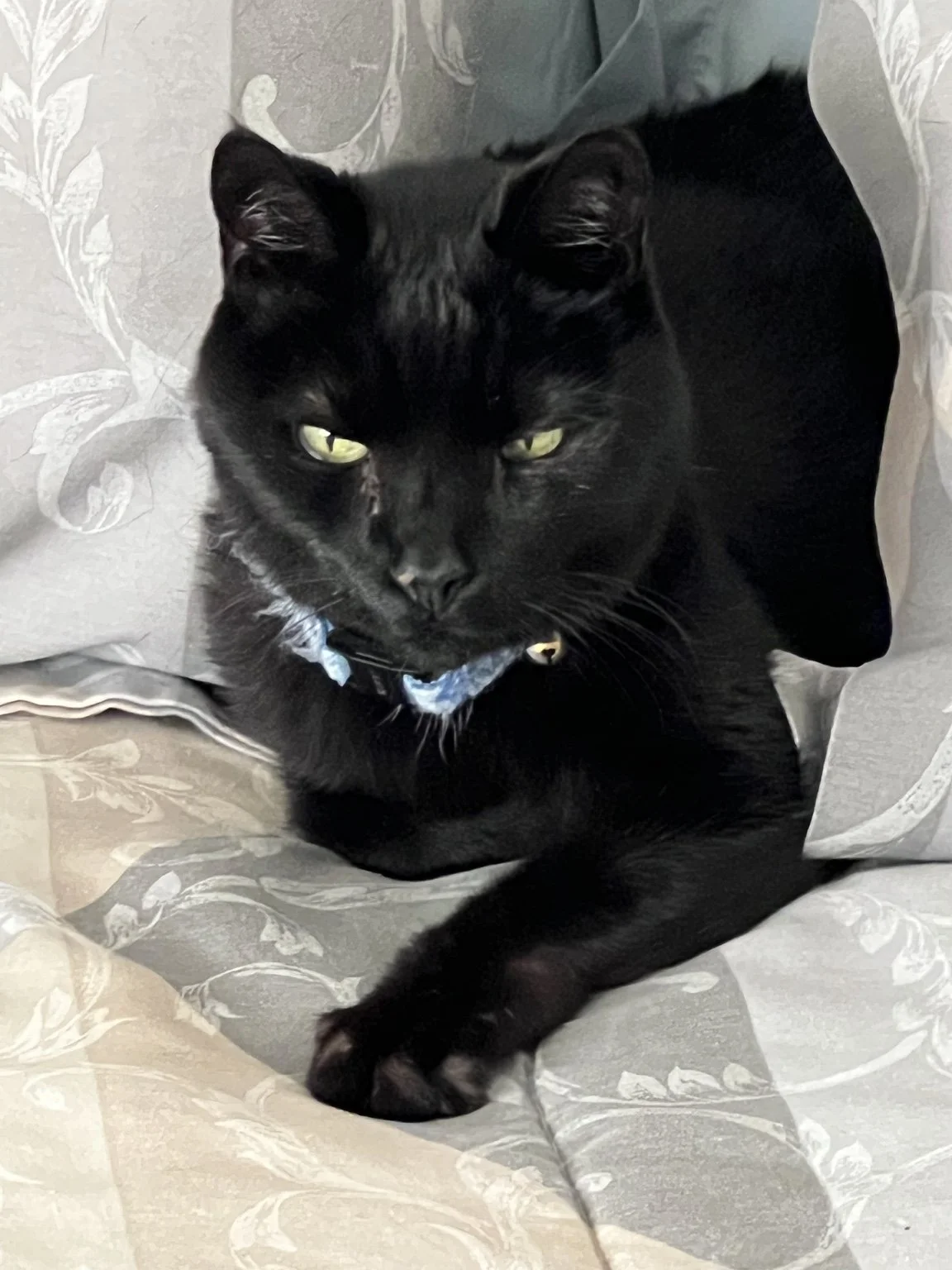
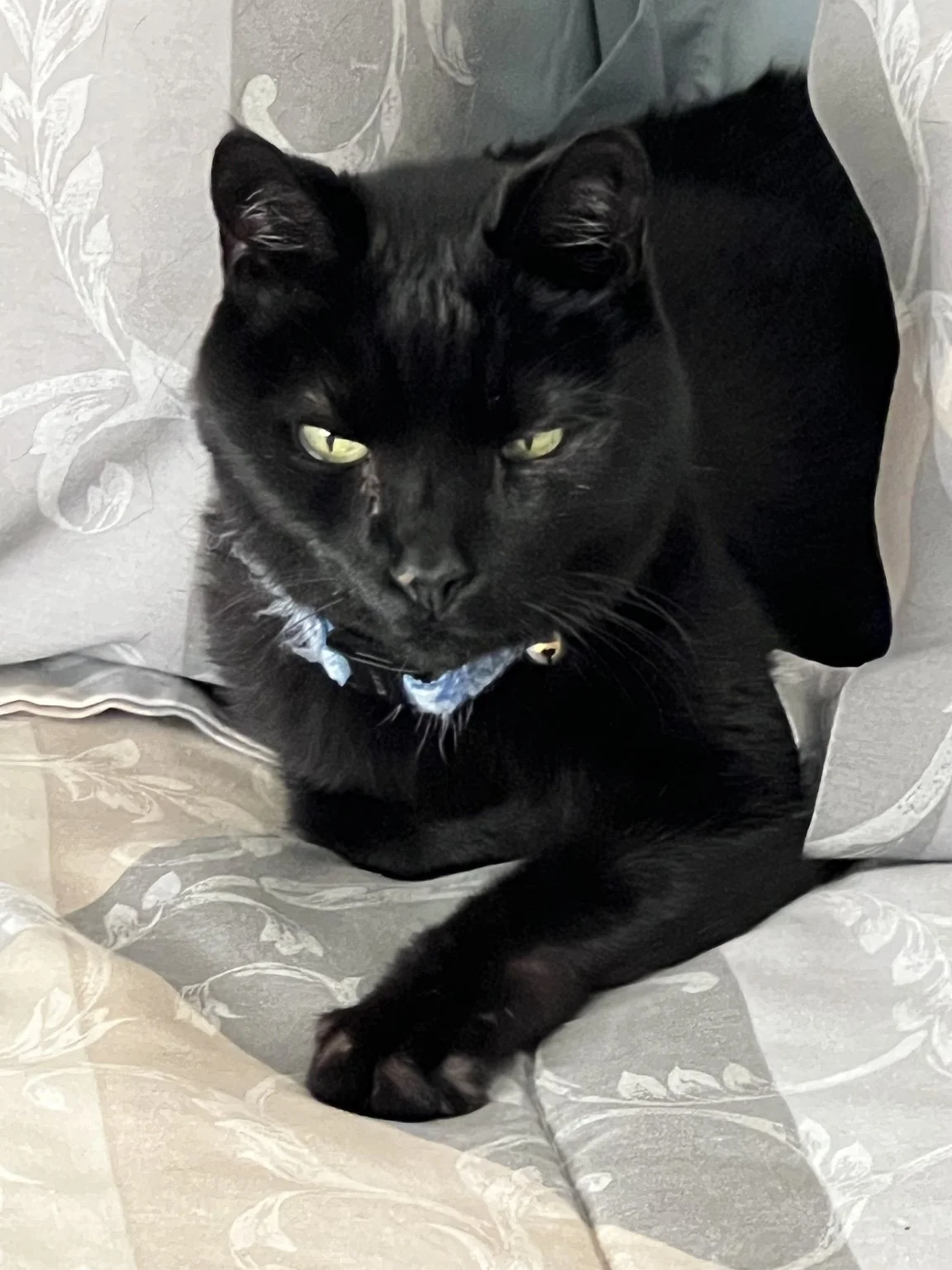
“Dude” to my mom. Fourteen years of family history in one little black cat.
When my son was three years old, I spent a lot of mornings lying on the couch with him.
It was 1996. I was pregnant with my eldest daughter and on bed rest, as I had been with my high-risk pregnancies. My little boy loved The Lion King, so we watched it endlessly—the way only a three-year-old can watch the same movie over and over and still believe this viewing is absolutely necessary.
Sometimes I watched with him. Sometimes I fell asleep.
All these years later, the opening still gets me. Elton John. "Circle of Life."
I understood even then that those mornings were precious. I savored them. What I couldn't yet understand was how differently the people I loved might be experiencing the very same moments—and how quickly the circle would turn.
A Halloween Kitten
In October 2012, the baby I had been carrying was about to turn sixteen.
She was my Halloween baby and an animal lover. Unlike the stereotypical teenager approaching her Sweet Sixteen, she wasn't asking for a car or an elaborate party.
She wanted a little black cat. That was it.
Outside, the remnants of Hurricane Sandy were battering Northeast Ohio. High winds and power outages closed schools across the Cleveland area, some for days. My kids and I were unexpectedly home. I had planned to wait until her birthday, but circumstances—and perhaps a little maternal impatience—changed the plan.
A tiny black kitten joined our family.
Dracula.
On October 30, she introduced him online with the kind of understated announcement only a teenager could make:
"You guys, meet Dracula. (:"
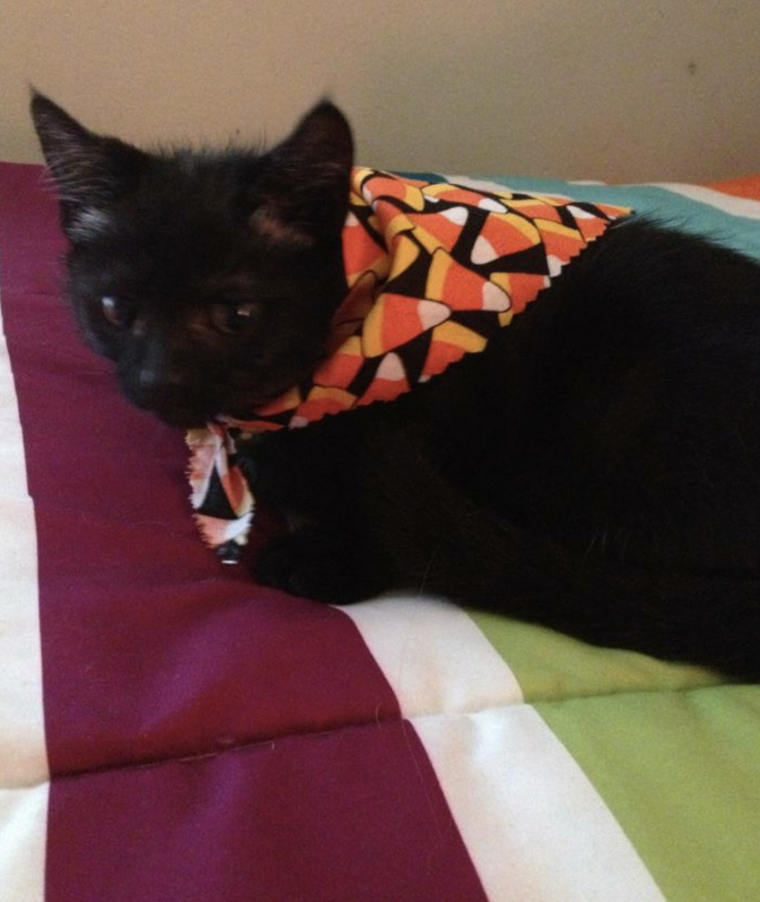
Dracula, October 2012. A little black kitten for a Halloween baby.
In the picture, the tiny black creature is wearing a candy-corn bandana.
Of course he is.
A black kitten for a Halloween baby, arriving during a hurricane. I couldn't have known everything that little cat would come to represent.
The Hurricanes Between Then and Now
There were hurricanes in our family, too. Not the meteorological kind.
There was an accident I didn't know how to handle. A divorce I didn't navigate the way I wish I had. Moves, relationships, and instability. Some of it was beyond my control.
Some of it wasn't.
I don't want to tell this story with the convenient wisdom of hindsight and claim I didn't know how precious the good moments were.
I did. I knew exactly how precious they were. I savored them.
I had poured enormous parts of my life into learning how to raise children well. I studied child development and education. I tried to practice what I understood to be best. My children weren't incidental to the life I was building; they were at the center of it.
That's what makes looking back so complicated.
While I was consciously creating and treasuring those moments, my children were sometimes carrying feelings they didn't tell me about. They were surviving our family's hurricanes, too. In ways that feel painfully familiar now, they may have contained what they felt—to protect me, to protect a peaceful moment, or simply because none of us knew what to do with all of it.
Perhaps the generational distance between my mother and me isn't as great as I'd like to believe.
Love, education, intention—even knowing many of the "right" things to do—did not make me immune to getting some very important things wrong.
Nor did I parent in a vacuum. Single mothers are expected to earn, care, organize, absorb, recover, and keep going under pressures the research documents well. That doesn't excuse my mistakes. It was simply the weather they happened in.
There are decisions I would give anything to make differently. My children lived with their consequences.
That doesn't erase the beautiful moments. It makes them more complicated.
There were children curled against me on couches. Movies watched a hundred times. Birthdays and animals and laughter and ordinary mornings. Moments when, whatever hurricane was raging around us—or inside me—I knew exactly what mattered.
My children. My family. Home.
And for fourteen years, Dracula remained.
Homes changed. Relationships changed. My children grew up, and their lives moved forward, as they were supposed to. Mine changed in ways I never could have anticipated.
But there was Dracula. Meowing. Wanting attention. Needing food. Being Dracula.
He was one of the last living pieces of that life—a daily connection to moments with my children that I cherished fiercely while we were living through hurricanes together.
Dude
My mother called him Dude. She's 83 now.
Recently, while I've been working beyond what I should to keep my business running and get employees properly in place before winter, Mom has been helping me with pet-care work. She has enjoyed it. It’s kept her active and makes her feel useful. Her last job was only about ten minutes from our apartment, so she could come home and check on Dracula. When neither of us was home last week, our neighbor friend cared for him.
Upon returning, she told us something unsettling. Dracula had tried to jump onto the counter, missed, and fallen backward, hitting the back of his head.
I don't know what role that fall ultimately played in what happened. We may never know.
But when Mom and I were both finally home Saturday night, Dracula wasn't right. He was terribly thin. By Sunday, I was very worried. I kept asking about him whenever I talked to Mom.
Monday morning, I texted her. No answer.
Eventually, I called. She'd just gotten back from Marc's. She was going to coffee. Later, she was coming over for chili.
When she arrived, she told me.
She had taken Dracula to the vet…. His lungs were filled…. He was gone.
I was devastated. And I was furious.
Why hadn’t she called me?
The veterinarian was five minutes away. I could have come home. I could have been there. I could have done something—even if that something ultimately changed nothing.
Instead, the decision had been made without my ability to say goodbye.
I was hurt. And I told her so.
What We Do With Hurt
Later, I texted my mother:
"He was the last living daily reminder of a life I cherished with my children."
As the day unfolded, I realized even that wasn't quite right. Dracula wasn't evidence of some idyllic family chapter I had lost. He was evidence that beautiful moments had existed inside the difficult ones—and that I had known they were beautiful while I was living them.
Mom responded:
"He will be with you forever. I am truly so sorry."
Then she told me something I wasn't expecting:
"Dude made me feel safe. Crazy but true."
I stopped.
This wasn't only my loss. My mother was grieving him, too. She simply wasn't grieving like me.
And there, underneath one little black cat and two devastated women, was something much older.
Generations.
My mother eventually wrote:
"I don't have a way to express my feelings."
And then:
"I was taught not to show feelings and no matter how hard I try I just can't. I carry everything inside."
There it was.
Not an excuse. An explanation. There is a difference.
My mother came from a generation in which emotional survival often meant containing things. You kept going. You didn't burden other people. You handled what needed handling and carried pain quietly, because that was what people did.
I am different. I need words. I need to understand. I need to say, You hurt me.
And, maybe even more importantly, I need the person I love to stay in the conversation after I say it.
So I told her the truth:
"I know. And I forgive you. I know it wasn't done maliciously, but that doesn't take away the hurt."
I've been thinking about that sentence ever since, because two things can be true.
I can understand why my mother did something and still be hurt by it. She can love me and make the wrong decision. I can forgive her without pretending it didn't matter. And she can explain herself without demanding that her explanation erase my pain.
Maybe this is where families so often lose one another.
Not in the original injury. In what happens next.
Stay in the Conversation
Eventually, children become old enough to look back and see the things their parents did that hurt them.
Then, if we become parents ourselves and live long enough, we gain another uncomfortable vantage point: we can see the ways we hurt our own children, too.
I certainly can. Understanding what I was going through at the time doesn't erase the consequences of my choices. Neither does loving my children beyond measure.
I loved them then. I love them now. And still, there are things I wish I'd done differently.
Perhaps that is one of adulthood's crueler gifts: we become old enough to understand our parents at the same time we become old enough to understand what our own children may someday have to forgive in us.
My mother and I could have stopped talking that morning. I was angry enough. She was hurting enough.
Instead, we kept going.
Our texts wandered through Dracula, guilt, illness, work, divorce, accidents, caregiving, regrets, and the strange ways mothers and daughters spend lifetimes worrying that they haven't done enough for one another.
At one point, Mom told me:
"I know you will always keep trying."
And then, in classic Mom fashion:
"You never were a quitter."
And somehow, after death and tears and anger and fourteen years of memories, my 83-year-old mother announced that she was going for a cool walk.
Life continued. It always does.
The Circle
That morning I lost Dracula. But I wasn't only grieving a cat.
I was grieving a sixteen-year-old Halloween baby who once wanted nothing more extravagant for her birthday than a little black kitten.
Children who aren't children anymore. Homes we once lived in. Versions of myself I sometimes miss, and versions I don't. Mistakes. Second chances. Ordinary mornings I knew were extraordinary while I was living them.
And underneath all of it, a three-year-old boy curled beside me on a couch while his pregnant mother drifted in and out of sleep as The Lion King played for what must have been the thousandth time.
The circle of life sounds poetic when you're young. At 56, it feels considerably less so.
Things begin. Things end. Children arrive and grow up. Parents age. Pets become family and leave before we're ready. We hurt people we love. People we love hurt us.
And sometimes, if we're fortunate, we get another conversation.
My mother couldn't give me back the phone call I desperately wish she had made. I couldn't give her words she was never taught to say. Neither of us could bring Dude back.
But we could keep talking. We could listen long enough to discover that underneath my anger was grief, and underneath her silence was grief, too.
Different generations. Different emotional languages.
Same little black cat. Same loss. Same love.
Maybe that's the part of the circle I'm still learning.
I've always been better at holding on than letting go. Maybe I don't need to learn how to hold on less. Maybe I need to learn that letting go doesn't mean leaving behind.
Some things we carry with us.
More Will Be Revealed
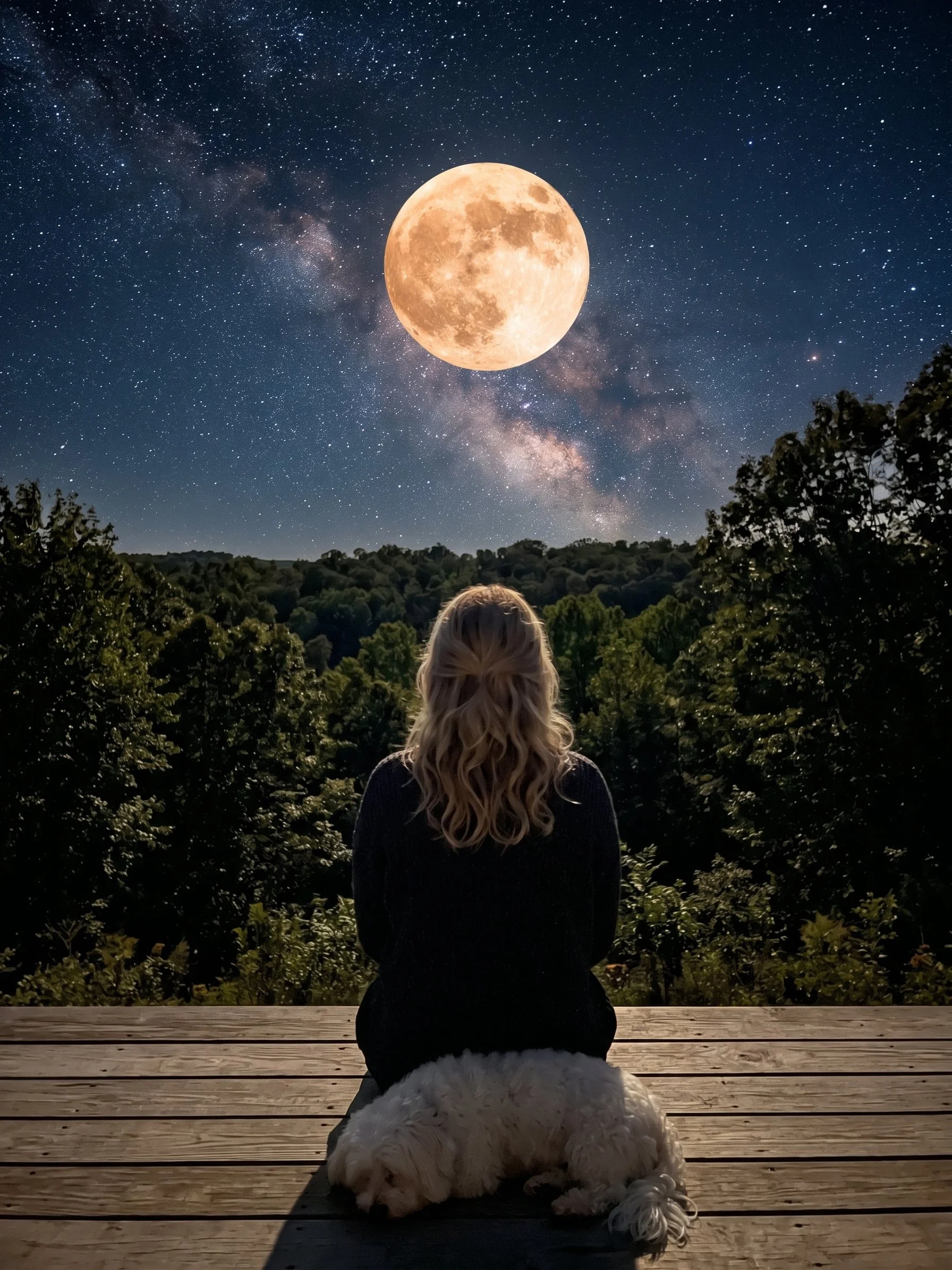
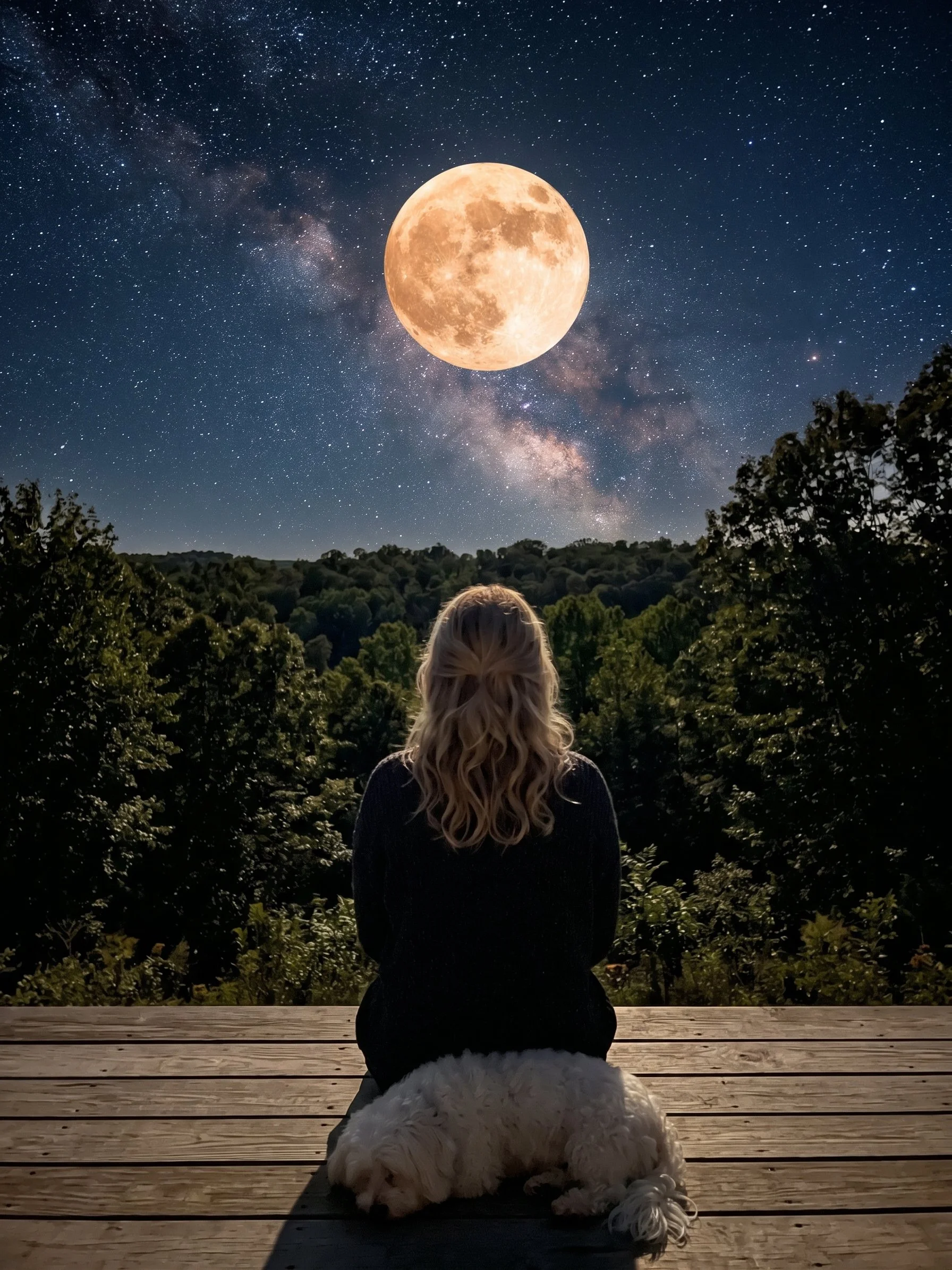
Reflecting on the August Sturgeon Moon with Maverick near and a special grandmother in my heart.
The moon was orange-yellow, glowing so bright it looked almost impossibly full.
I was sitting outside on an overnight pet-care job, a little dog named Maverick curled near my feet. The night air had that particular late-August thickness to it — warm, a little damp, the cicadas starting to thin into quiet. I looked up, and the light stopped me. I sat there for a long moment just admiring it.
And as I sat there, I thought of a woman named Sunnie B. Eastridge.
Only afterward did I check the date.
August 29. Five years, to the day.
Five years earlier, on August 29, 2021, I was supposed to be saying goodbye.
I didn't know that day would become the day I lost not only a woman I loved, but the last of an illusion I had carried for years.
August 14, 1930 — August 29, 2021. She was 91 years old when she died in Hillsboro, Ohio.
To the outside world, she was my former husband's grandmother.
To me, she was Grandma Eastridge.
And she had made it very clear that our relationship did not end when my marriage did. That mattered. More than I think I understood at the time.
I met Sunnie because I married her grandson. But somewhere along the way, she became my grandmother — not because a marriage certificate said so, but because she said so.
She was sweet and charming, with a spirit that treasured the things I treasure: legacy, nostalgia, family stories, traditions, the ordinary pieces of a life that become extraordinary because someone remembers them.
I loved being in her kitchen. I can still see myself there in Hillsboro, standing with her while she taught me how to make Swiss steak. Thin cuts of sirloin simmered in tangy tomato sauce. Green bell pepper. Sweet Vidalia onion. White mushrooms.
“Some basil and oregano,” she'd say, sprinkling them in without measuring.
And then there were the two bay leaves. I had never seen a bay leaf before. She showed them to me.
It is funny what stays. Not the grand occasions. Not the photographs. Sometimes it's two dried leaves in the hand of a woman who loved you.
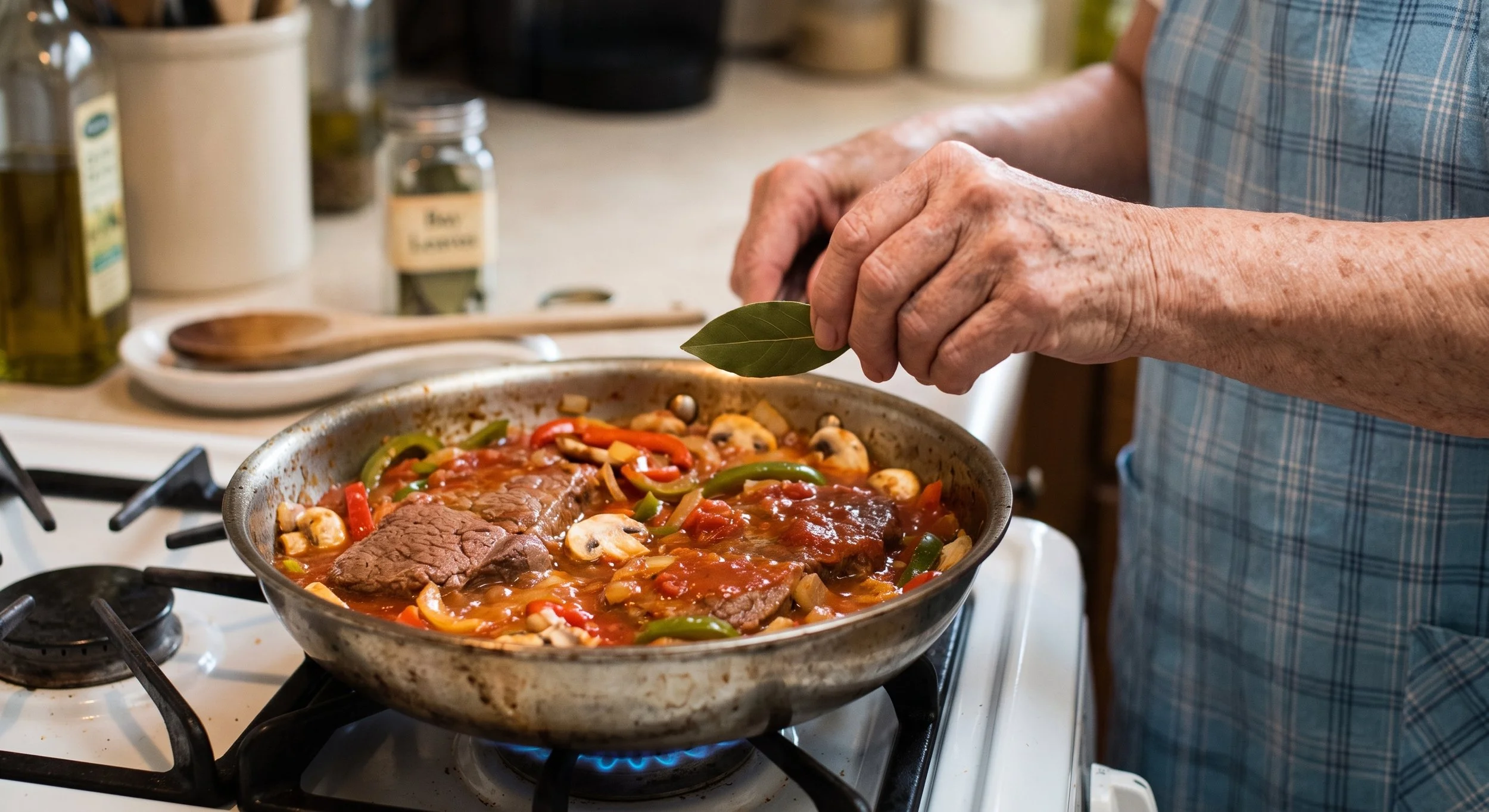
After my divorce, I tried to maintain those relationships. Birthday cards. Christmas cards. Calls. Social media.
And Sunnie made her position unmistakably clear. When I became engaged to another man, she reminded me that I would always be her granddaughter. She wanted to meet him. She told him, too.
I believed her. Because I knew she meant it.
And perhaps that is why what happened five years ago hurt so much.
In the years following my divorce, I remained tangled in something I would eventually come to understand as a very long, very painful case of limerence. I had spent an enormous part of my life believing that somehow, someday, my family would find its way back to itself. An intact, loving, healthy nuclear family had been everything to me. It wasn't simply something I wanted. It was the legacy I had poured myself into creating.
So even when circumstances should have told me otherwise, some part of me continued looking for evidence that the story wasn't over.
Months before Sunnie's death, my former husband had said something to me that I will never forget.
“Lis, maybe it's God's way of protecting you from me.”
I heard the words. I didn't understand them. Not yet. I was still trying to save something I didn't realize I had already been released from.
There had been plans for me to go to Hillsboro. Twice before, dates had been given to me, and the trips had been canceled.
Then, in August 2021, Sunnie's health was failing. I was told she was going to die soon — but not by the person who had promised I would be there.
I learned that my former husband and my daughter were already on their way to Hillsboro to say goodbye.
I wasn't going. I had not been invited.
There was no warning. No final phone call. No video call. No opportunity to tell Sunnie what she meant to me.
I don't even remember exactly what happened in the hours afterward. That summer had already been exceptionally difficult. There were other things happening — things that, at the time, I couldn't possibly process all at once.
What I remember most clearly is the feeling of being further and further excluded from everything.
And I remember the grief. Not just grief for Sunnie. Grief for what I thought my family was. Grief for what I thought might still become. Grief for a future I had spent years trying to resurrect. And grief for the awful realization that sometimes a person can be standing outside a door they thought was still open without realizing that it had been closed a long time ago.
I don't know whether Sunnie knew I wasn't there. I believe she knew I loved her. I believe she may have asked about me. And I believe she was never told.
I have no way of knowing that for certain. That uncertainty used to torment me.
Now, it doesn't. Because I know something else. She knew me. She knew who I was. She knew that I loved her. And she had already told me the thing I needed most to hear.
You will always be my granddaughter.
That was hers to give. And nobody could take it back.
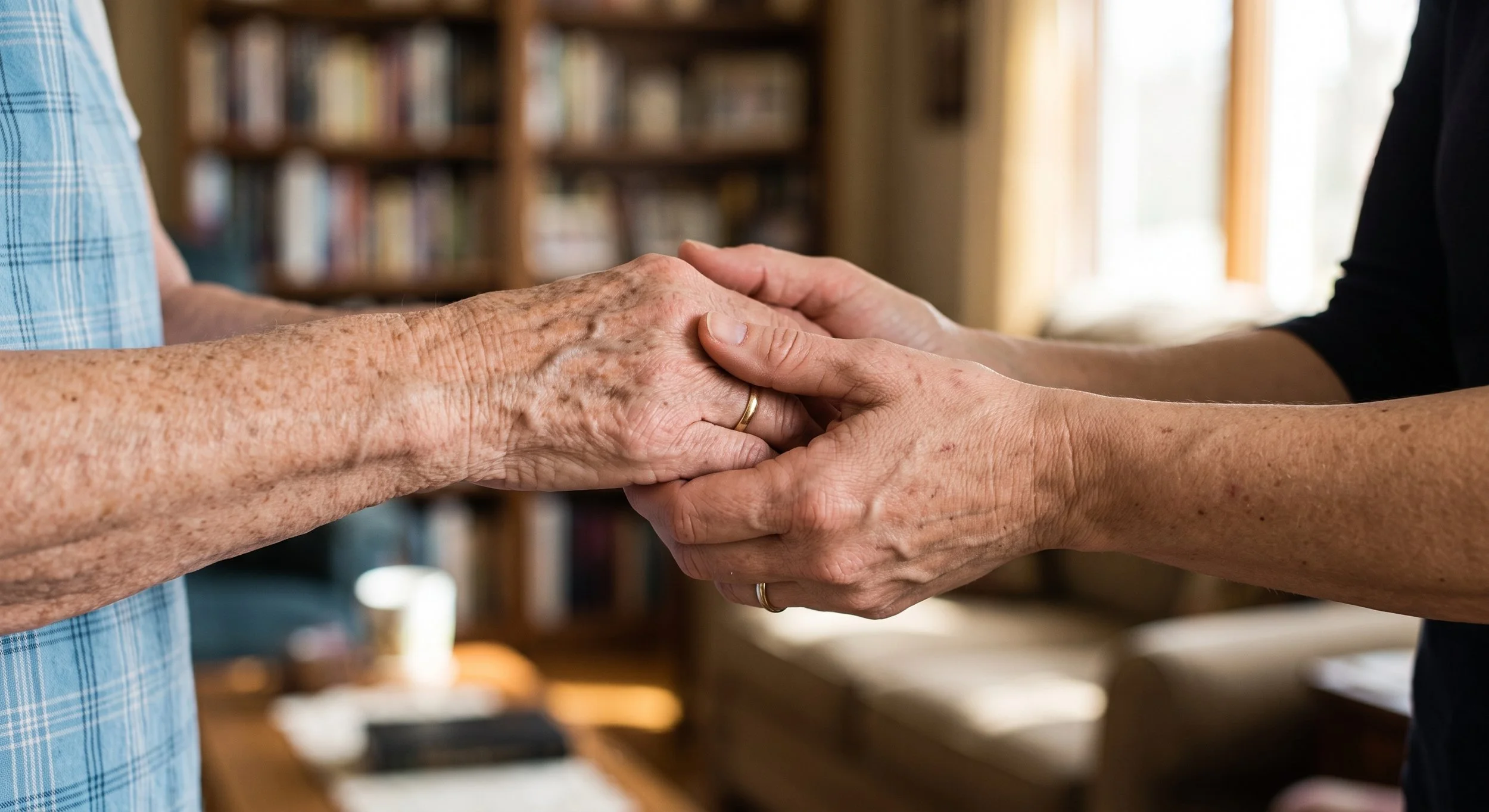
There is a phrase familiar to many people in recovery:
More will be revealed.
It is a reminder not to demand immediate answers from a life that is still unfolding. Sometimes we simply cannot see what something means while we are living through it. We want the explanation. We want the apology. We want the missing pieces. We want someone to tell us why.
But sometimes the answer comes years later. Not as an explanation. As understanding.
For me, Sunnie's death became a kind of brick wall. I hit it hard. It took years to understand that the pain wasn't only about being denied the opportunity to say goodbye to a woman I loved. It was also the moment when life began dismantling an illusion I had protected for decades.
I had to learn to let people be who they were. I had to stop trying to force relationships into the shape I desperately wanted them to have. I had to stop confusing my capacity to love with someone else's capacity — or willingness — to love me in the same way.
And eventually, I learned the words that have become so freeing to me:
Let them.
Let them misunderstand. Let them choose. Let them walk away. Let them tell whatever version of the story they need to tell. Let the door close.
And then — let yourself walk through another one.
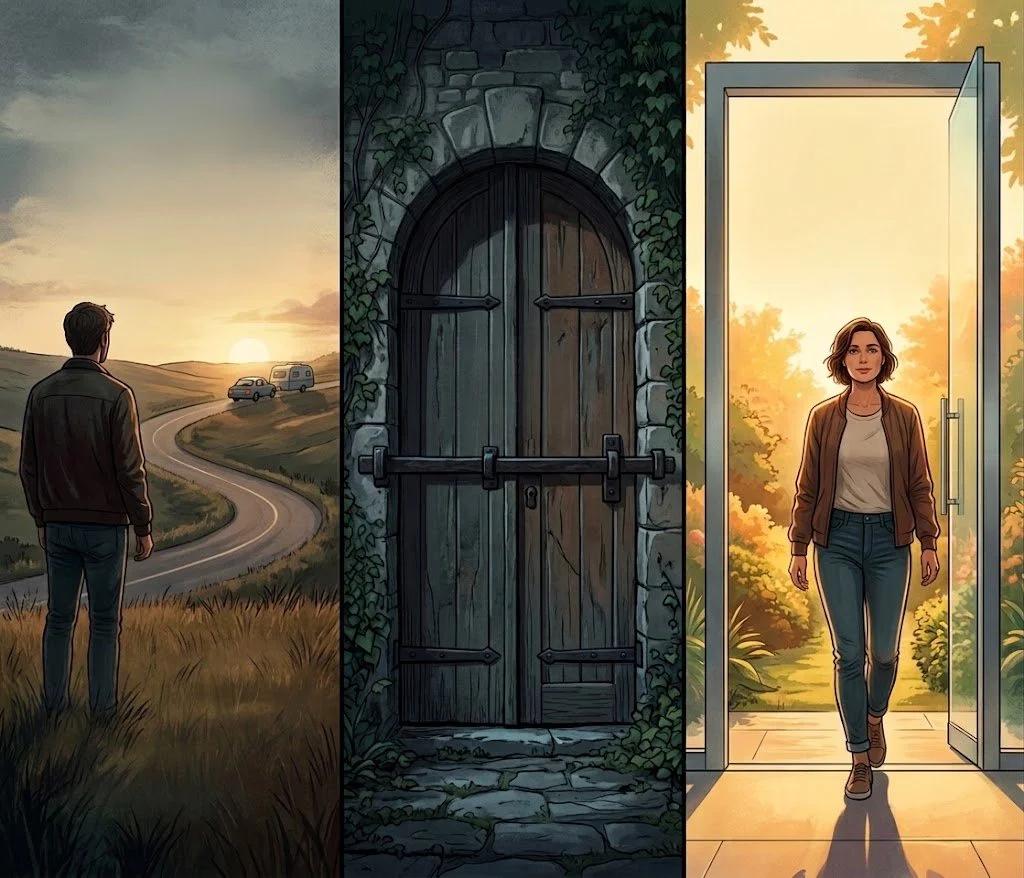
Five years passed.
And on August 29, 2026, I sat outside with Maverick under that same brilliant, orange-yellow moon.
It looked almost impossibly full — but I later learned that it wasn't, quite. The full Sturgeon Moon had peaked just after midnight on August 28. By the 29th, it had technically begun to wane — a waning gibbous moon, still almost completely illuminated and still looking full to the naked eye.
I found that strangely fitting.
Because perhaps grief is like that. Something can begin to wane without becoming less beautiful. Something can move away without disappearing. Something can no longer be physically present and still illuminate parts of you that might otherwise remain dark.
Five years ago, I was desperate for someone else to give me permission to say goodbye.
This year, I simply remembered her. And I smiled.
Because Sunnie is no longer trapped in the circumstances of her death. She is in the kitchen with me. She is in the Swiss steak. She is in the bay leaves. She is in the stories. She is in the birdhouse Grandpa Eastridge made by hand and gave to my mother. She is in the part of me that still believes our lives are made richer by remembering where we came from and the people who helped shape us.
And she is in the legacy I carry forward.
I saw her. I knew her. I knew her for herself.
Despite whatever jealousy, fear, insecurity, or control may have existed around her, I knew what I experienced with her. It was sincere. It was real. It was love.
So, Grandma Eastridge —
I love you so much. And I am blessed to have had you in my life.
You told me I would always be your granddaughter. You were right.
And now I understand something else: some goodbyes are not given to us by other people. Sometimes, after all the fighting and grasping and questioning and grieving, we discover that the goodbye was never really the point.
The love was.
And the moon keeps shining. Even as it wanes.
More will be revealed.
And sometimes what is revealed is that the door behind you needed to close so you could finally turn around and see the road ahead.
Grandpa and Grandma Eastridge remain part of mine. Not in my past. In my future. Carried forward in the beautiful spirits they left behind.
And that, finally, is peace.

What the Water Taught Me
At 4 a.m., holding a dog collar silent for thirteen years, a woman remembers the lesson a mentor once gave her: everything is on loan, and gratitude doesn't require understanding why.

Skyline of Cleveland, Ohio over Lake Erie
What the Water Taught Me
It is 4:11 on a Friday morning, and I can't sleep.
I'm exhausted.
Not the ordinary kind of tired that a good night's sleep can fix. I'm tired in a way that has accumulated over decades—layer upon layer of fighting, adapting, hoping, planning, sacrificing, rebuilding, and trying again.
Tonight, I reached for Zoe.
Her collar has hung from my bedpost since she left us thirteen years ago, but tonight I took it down and held it.
I don't know exactly what I was looking for.
Maybe her.
Maybe the woman I was when she was still here.
Maybe the feeling of being loved by someone who didn't require me to accomplish anything first.
Somehow, after all these years, her collar still carries a connection to hope and faith that I can't quite explain.
Maybe that's why I needed it tonight.
I've spent a lifetime believing in better days.
I've made plans. Big plans. Best-laid plans.
I've worked hard. I've contributed. I've sacrificed. I've believed that if I just kept going, kept learning, kept adapting, eventually the pieces would fall into place.
Sometimes they did.
Sometimes they didn't.
And sometimes I wasn't even capable of seeing what was right in front of me.
David Foster Wallace illustrated that kind of blindness beautifully in This Is Water.
Two young fish encounter an older fish swimming the opposite direction.
"Morning, boys. How's the water?"
They swim on for a while. Then one looks at the other and asks:
"What the hell is water?"
I've thought about that story a lot.
How often do any of us swim through something so completely we can't recognize it—the exhaustion, the striving, the quiet certainty that we're owed something for it all—until someone asks the simple question: what is this, exactly?
How many things have I mistaken for normal simply because they were familiar?
There is a difference between hope and denial.
I've learned that the hard way.
I've also learned that I am entitled to nothing.
That may sound harsh, but it is actually one of the most beautiful lessons I've ever been given.
I was in my early twenties, working at a bridal and formal boutique after suffering two miscarriages. I was bitter. I was married, while several of my unmarried friends were having babies, and I couldn't understand why God was allowing this to happen.
A colleague and spiritual mentor, Karen Pritchett, asked me to imagine that someone showed up at my door and handed me a dollar for no reason.
I'd be grateful.
Then imagine they came back the next day with another dollar.
And the next.
And the next.
Until one day, they didn't.
The dollar was never mine. It had always been a gift.
Karen gave me that wisdom more than thirty years ago, and I have carried it ever since.
Everything is on loan.
Our parents. Our friends. Our partners or spouses. Our children. Our homes. Our sources of income. Our health. Our animals.
We don't truly possess any of it.
We are entrusted with these gifts for a time.
To believe that we have earned them—that our work, sacrifice, or goodness somehow makes us entitled to keep them—is to misunderstand the very nature of a gift. It places us in the position of owner rather than steward, as though we are the masters of our own lives rather than recipients of what God, in His sovereignty, has chosen to place in our hands.
Everything is on loan.
And perhaps that is why gratitude matters so much.
We don't have to understand why a gift was given, or why it was taken away, to be grateful that we were given it at all.
That doesn't mean we don't grieve when something is gone.
It means we can grieve and still be grateful that we were given it at all.
I can say thank You for Zoe.
Thank You for the years.
Thank You for the people.
Thank You for the life I was given—even the parts I never would have chosen.
I've spent years battling un/misdiagnosed dystonia. Then came years of Long COVID, adding another layer of uncertainty, exhaustion, and loss. Since August of 2020, I've committed myself to a program of recovery—body, mind, and the relationships that hold me up. I've kept learning, growing, and waiting for more to be revealed.
Sometimes that journey has felt remarkably like Job.
When the explanations stop working.
When the neat answers disappear.
When you find yourself sitting in the ashes, wondering what the hell happened to the life you thought you were going to have.
I don't have a tidy answer tonight.
I'm tired.
Really tired.
It's now 5 a.m., and I'm still here.
Holding the collar of a dog who has been gone for thirteen years, I'm still here.
Zoe used to shake—physically shake—whenever one of us was upset, as if her whole small body needed to feel what we felt before she could settle. She taught my children and me more about emotional regulation than any book ever did, just by trembling through our storms until they passed.
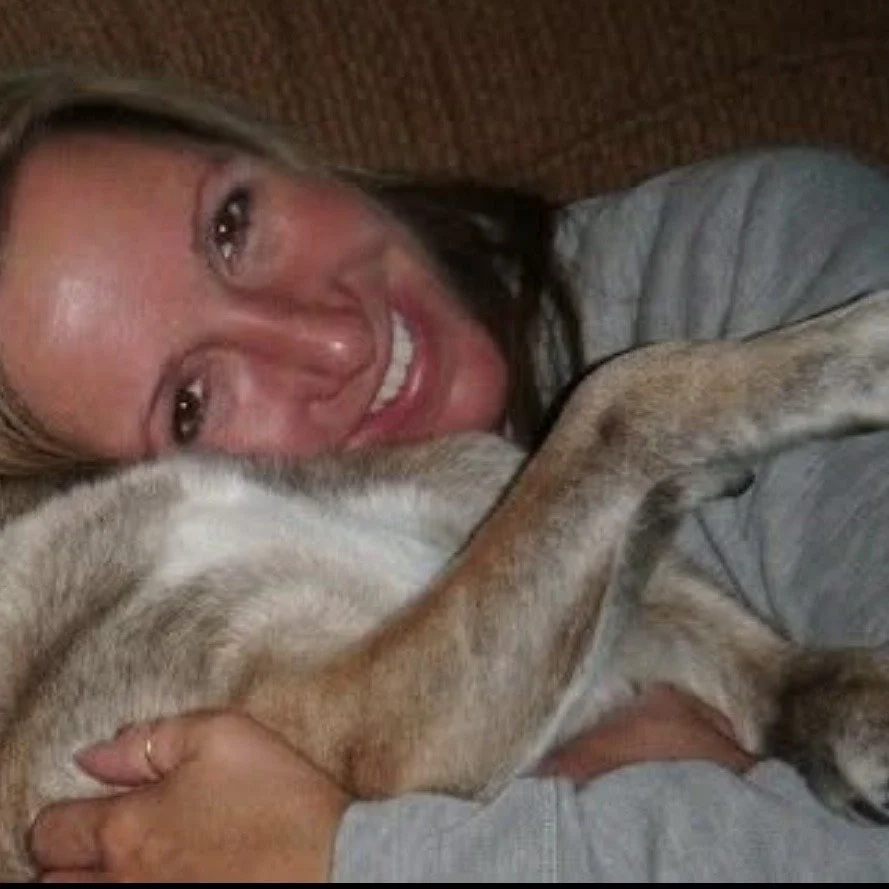
Zoe and Me
And somehow, in that collar and the memories it carries, I can feel something I haven't completely lost.
Hope.
Faith.
Love.
Not the shiny, uncomplicated kind.
The kind that survives disappointment.
The kind that says, I don't know what happens next, but I don't have to know yet.
Maybe this is what I've been waiting to learn.
Recovery isn't necessarily getting back the life we've planned.
Faith isn't believing everything will turn out the way we want.
Hope isn't pretending reality isn't hard.
Sometimes hope is simply refusing to believe that the hardest chapter is the only chapter left.
Zoe can't come back.
The years can't come back.
Some things cannot be restored in the form I once imagined.
But love remains.
Lessons remain.
Faith remains.
Gratitude remains.
And I remain.
So when morning comes, I'll decide what to do with what I have now.
Not what I wish I had.
Not what I thought I would have by this age.
Not what my best-laid plans promised me.
What I have now.
Because maybe that is the real question:
What will I do with this now?
I'm tired.
But I can keep going.
Maybe not the way I once thought I would.
Maybe not as quickly.
Maybe not with the same certainty.
But I can keep going.
I'm still learning to recognize the water I've been swimming in.

Lake Mohawk, Ohio
And for tonight, that is enough.

The Starter Wife Series Part 3: Seeing Her
For many women, the hardest person to truly see was themselves. This final reflection explores identity, healing, and the quiet realization that after years of meeting everyone else's expectations, we finally have the opportunity to live our own.
I've been thinking about all those messages many Gen-X women received growing up.
Be nice.
Be pretty.
Be accommodating.
Be supportive.
And if we're being honest, many of us got very good at all of those things.
What I find interesting is that I never really lost myself.
Not completely.
The dreams I had as a teenager are remarkably similar to the dreams I have today.
The difference is that somewhere along the way, I convinced myself those dreams could wait.
I settled for being admired instead of being known.
For being appreciated for my appearance rather than understood for my mind, my heart, my humor, my ambition, and my purpose.
I don't think I'm alone.
Many women of my generation built beautiful lives, raised wonderful children, and loved their families deeply.
But somewhere beneath the responsibilities, the schedules, the sacrifices, and the expectations was the same girl she'd always been.
Still waiting.
Still dreaming.
Still hoping someone would see her.
The irony is that after all these years, the person most responsible for seeing her has always been me.
And thankfully, she's still here.
Older, wiser, and finally free to become everything she was meant to be all along.
And I have a feeling she's just getting started.
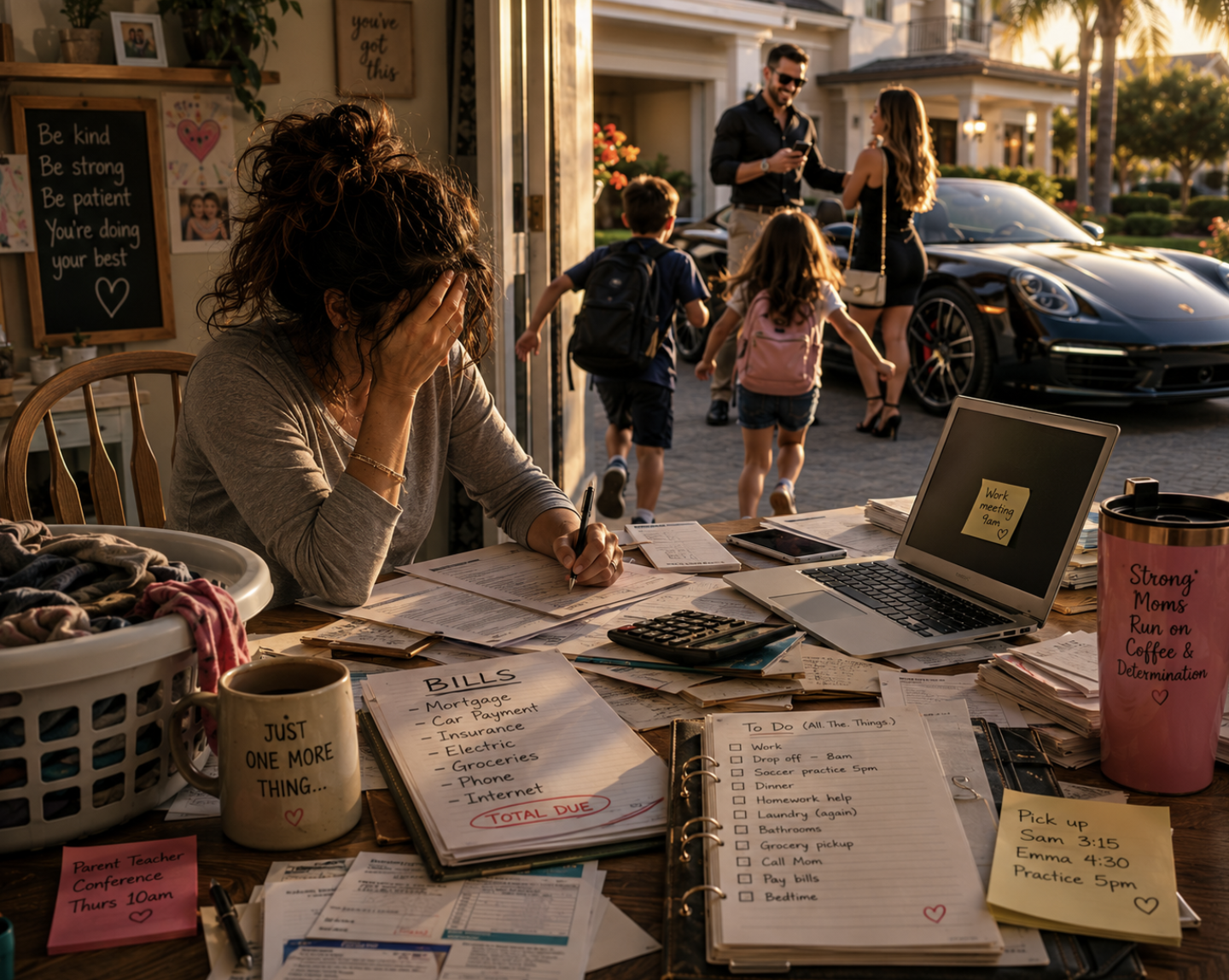
The Starter Wife Series Part 2: What it Cost Us
Many Generation X women became experts at caring for everyone except themselves. This reflection explores the hidden cost of self-sacrifice, the expectations placed on women, and why reclaiming our own voices may be one of the greatest gifts we leave the next generation.
Single parents face major hurdles, most notably financial constraints, overwhelming time management demands, and persistent emotional stress.
For generations, women were taught that being "good" meant being agreeable.
Helpful.
Selfless.
Accommodating.
We learned to anticipate needs, smooth over conflicts, carry emotional burdens, and put ourselves last.
Many of us became experts at caring for everyone except ourselves.
And for some women, the rewards never came.
After years of carrying the invisible load—raising children, managing households, supporting careers, and putting everyone else first—they found themselves starting over while others moved on as though none of it had happened.
The irony?
The older I get, the more I realize that self-sacrifice and self-worth are not the same thing.
Love does not require exhaustion.
Compassion does not require martyrdom.
And boundaries are not selfish.
Perhaps the greatest gift we can give the next generation is permission to be fully human.
To speak.
To rest.
To change their minds.
To pursue their own dreams.
To care deeply for others without abandoning themselves.
Maybe the goal was never to be "sugar and spice and everything nice."
Maybe the goal was simply to become ourselves.
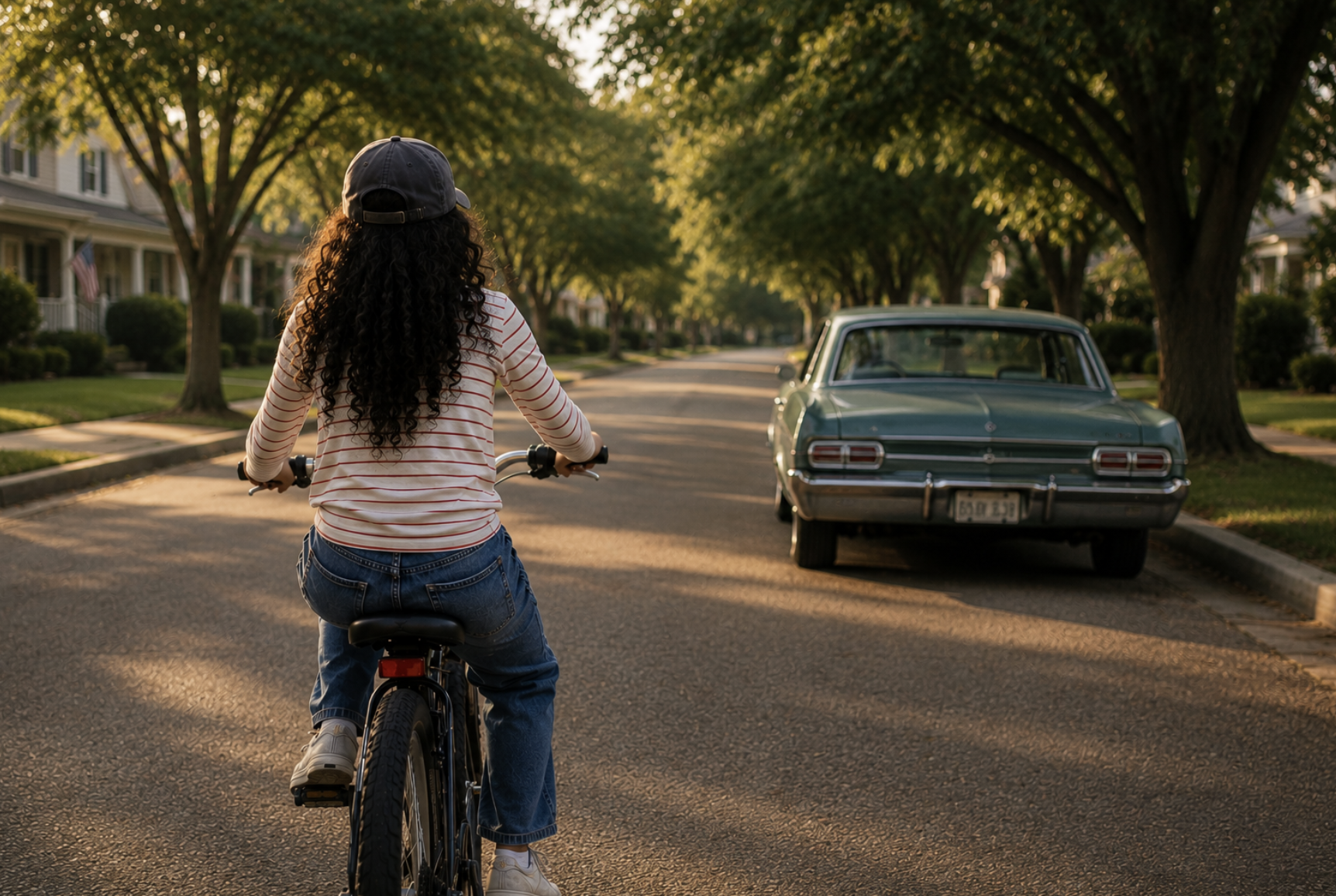
The Starter Wife Series Part 1: Pretty. Pleasant. Chosen.
What messages did Generation X girls grow up hearing about beauty, marriage, and what it meant to be a "good" woman? This first post explores the quiet expectations many of us accepted without question—and how those early lessons shaped the lives we would later build.
We didn't grow up hearing just one message about what it meant to be a woman.
We grew up hearing hundreds of them.
Some arrived disguised as nursery rhymes.
"Sugar and spice and everything nice."
Others were spoken by parents, teachers, clergy, television personalities, and well-meaning relatives.
"Little girls should be seen and not heard."
"Be nice."
"Don't be bossy."
"Act like a lady."
"Someday you'll make a wonderful wife and mother."
And perhaps the most powerful message wasn't spoken at all.
Pretty girls got noticed.
Pleasant girls got praised.
And many of us quietly learned that being chosen mattered more than being known.
By the time many of us reached adulthood, these messages had woven themselves into our understanding of who we were supposed to be.
For Generation X women especially, the contradictions were impossible to miss.
We were told we could be anything we wanted to be.
But we were also taught that a woman's value was often measured by how much she sacrificed for everyone else.
We were encouraged to pursue an education.
But we were still expected to be the primary caretaker.
We were told to be independent.
But not too independent.
Strong.
But not intimidating.
Confident.
But not outspoken.
Successful.
But never at the expense of our families.
Many of us entered young adulthood carrying these competing expectations into our marriages, careers, and motherhood. We became the generation that attempted to do it all—build careers, raise children, maintain homes, support aging parents, and somehow still smile through exhaustion.
The challenge wasn't simply the workload.
It was the invisible weight of decades of cultural messages telling us that our worth was tied to how much we could carry.
Only now, decades later, are many women beginning to ask a different question:
What if our value was never determined by our ability to endlessly give, accommodate, nurture, and sacrifice?
What if being "everything nice" came at a cost?
And what if the next generation deserves a different message altogether?
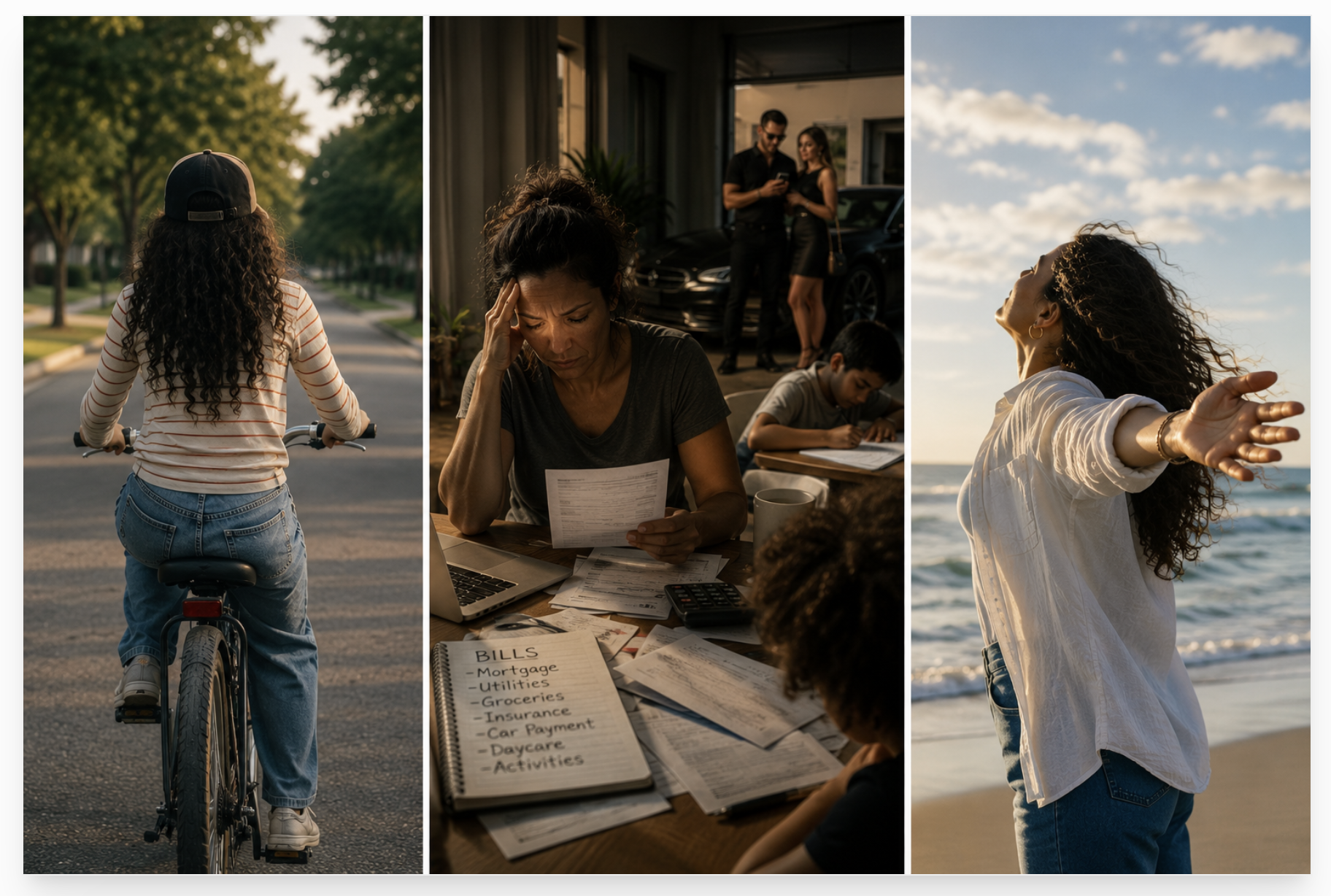
Intro: The Starter Wife Generation
We were taught that being "good" meant being agreeable, pleasant, chosen. Somewhere underneath the sacrifices and the schedules, though, is a girl who never really left — and it's time to find her.
Over the next three posts, I'm exploring the messages many Generation X women grew up with, what those messages cost us, and what we discover when we finally start listening to ourselves. ✨
We didn't grow up hearing just one message about what it meant to be a woman. We grew up hearing hundreds of them — in nursery rhymes, in offhand comments from relatives, in the quiet understanding that pretty girls got noticed and pleasant girls got praised. For Generation X women especially, those messages arrived wrapped in contradiction: be independent, but not too independent. Be successful, but never at the expense of your family. Be everything, to everyone, all the time.
The Starter Wife Generation is a three-part series about what happened next — about the women who built careers, raised children, held households together, and carried decades of invisible weight, only to realize somewhere along the way that self-sacrifice and self-worth were never supposed to be the same thing.
This series is personal, and it's universal. It's for every woman who was taught to be "sugar and spice and everything nice," and who is only now starting to ask what she actually wants.
Over the next few posts, we'll explore:
Part 1 — Pretty. Pleasant. Chosen. The messages we absorbed before we ever had the words to question them.
Part 2 — What It Cost Us. The real price of a lifetime spent putting everyone else first.
Part 3 — Finding the Girl Who Never Left. What it looks like to come home to yourself, decades later.
Before you dive in, take a moment to find out where your own story fits. Take the quiz — Have You Found the Girl Who Never Left? — and let's find her together.
Have You Found the Girl Who Never Left?
You learned to be nice. Pleasant. Chosen. Somewhere underneath the schedules and the sacrifices, though, is the girl you were before all of that. This short quiz will tell you where you are on the way back to her.
Part of "The Starter Wife Generation" series
The Pleasant One
Pretty girls got noticed. Pleasant girls got praised. Somewhere along the way, you learned that being chosen mattered more than being known — and you got very good at it. Agreeable isn't the same as fulfilled, and it's never too late to find out who you are underneath the nice.
This is where your story starts.
Read Part 1: Pretty. Pleasant. Chosen. →The One Who Carries It All
You've spent years managing everyone's needs but your own — the invisible load of raising, holding, supporting, and smoothing things over. You learned that self-sacrifice and self-worth were the same thing. They were never supposed to be.
Your story continues here.
Read Part 2: What It Cost Us →The Girl Who Never Left
Underneath the schedules and the sacrifices, she's still there — the same girl who once had big dreams, still waiting to be seen. The good news is that the person most responsible for finding her again has always been you. And she's just getting started.
Meet her, fully, here.
Read Part 3: Finding the Girl Who Never Left →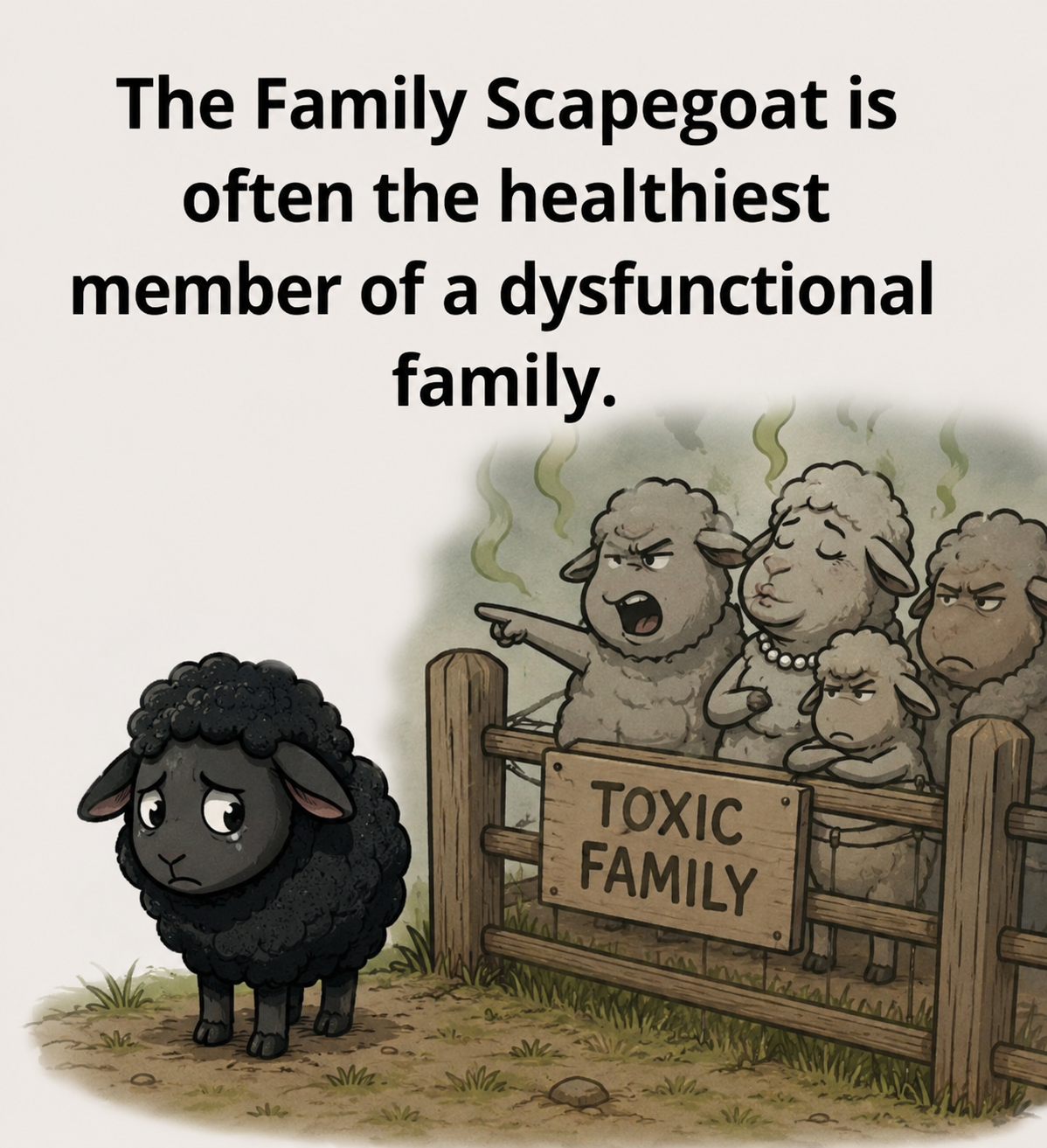
When Family Harm Hides Behind “Love”
There’s a particular kind of grief that comes from finally understanding the truth after your children are already grown.
Not the grief of death.
Not the grief of divorce.
Not even the grief of betrayal alone.
It’s the grief of hindsight.
It’s realizing that behaviors you once excused as “difficult personalities,” “old-fashioned parenting,” “family drama,” or “that’s just how they are” were actually harming your children while it was happening — and you did not fully see it.
That realization can hollow a person out.
For years, I believed endurance was strength.
I believed keeping the family together mattered more than conflict.
I believed children benefited from grandparents simply because they were grandparents.
I was wrong.
And that truth is painful to write.
What I Mean by “Emotionally Harmful Behavior”
Before going further, I want to be clear about something.
This article is not about assigning clinical diagnoses to family members. It is about patterns of self-centered and emotionally harmful behavior that can exist inside families for generations without being recognized for what they are.
I’m referring to behaviors such as:
manipulation disguised as love,
chronic guilt-tripping,
disrespect for boundaries,
emotional control,
favoritism,
undermining parents,
emotional invalidation,
and making relationships revolve around power, attention, or obedience instead of emotional safety.
These high-control family dynamics often become normalized over time, especially when they are woven into family culture and tradition.
The Myth That Family Automatically Equals Safety
Many of us were raised to believe family loyalty is sacred no matter the cost.
We were taught:
Respect your elders.
Don’t question parents.
Keep the peace.
Forgive endlessly.
Ignore hurtful comments.
“That’s just how they are.”
So when emotionally harmful behavior appeared in the family system, it often went unnamed.
Instead, it became normalized.
The manipulation.
The guilt.
The criticism disguised as concern.
The competition.
The emotional control.
The undermining.
It blended into everyday life so thoroughly that we stopped seeing it clearly.
And our children absorbed it while we were trying to survive it.
High-Control Family Dynamics Affect Everyone in the Home
Looking back, I can now see patterns that once confused me.
The constant boundary violations.
The favoritism.
The subtle triangulation.
The emotional games.
The attempts to create dependency.
The criticism of parenting decisions.
The rewriting of events.
The need to remain the emotional center of the family.
At the time, I thought I was managing difficult relationships.
I did not realize my children were learning from them.
Children learn what love looks like by watching relationships unfold around them.
When manipulation becomes routine, children may begin believing:
love requires emotional sacrifice,
boundaries are disrespectful,
guilt equals responsibility,
peacekeeping matters more than honesty,
and emotional survival means suppressing themselves.
That is not something a parent easily forgives themselves for once they finally understand it.
The Most Dangerous Part Is How Subtle It Can Be
Emotionally harmful family systems are rarely obvious from the outside.
There may not be screaming.
There may not be physical violence.
There may even be generosity, gifts, praise, or public affection.
That is what makes it so confusing.
The control often hides beneath:
“helpfulness,”
“concern,”
“tradition,”
“family closeness,”
or financial support.
Sometimes children are rewarded for loyalty and punished emotionally for independence.
Sometimes one child is idealized while another is criticized.
Sometimes grandparents undermine parental authority quietly enough that the parent questions their own instincts.
Sometimes the parent has been conditioned since childhood to tolerate behavior they should have challenged.
That conditioning runs deep.
By the Time You Understand It, the Damage May Already Exist
This is the part people rarely talk about openly.
Sometimes awareness comes late.
Very late.
Sometimes your children are already adults before the full picture finally becomes undeniable.
And when that happens, a parent can drown in guilt.
You replay conversations.
Holidays.
Arguments.
Moments you dismissed.
Moments your children tried to tell you something.
Moments you silenced your own instincts because you feared conflict, rejection, abandonment, or being called “ungrateful.”
You start realizing:
“They would have kept lying if I never found out.”
And suddenly your entire history rearranges itself.
The Weight of Maternal Regret
There is no easy way to describe the pain of realizing your children experienced emotional harm while you were still trying to understand your own.
Especially when you genuinely believed you were doing your best.
Mothers carry enough guilt already.
But this kind is different.
This guilt whispers:
“You should have known.”
And maybe there were moments when the truth was staring me directly in the face.
Moments I explained away.
Moments I minimized.
Moments I ignored because I believed honesty, accountability, and love would eventually matter more than manipulation.
I was raised to tell the truth, own my mistakes, and teach my children to do the same.
So when I found myself surrounded by people who believed parents should never admit wrongdoing to their children — people who normalized lying, denial, blame-shifting, and protecting appearances at all costs — I should have recognized how deeply unhealthy that was.
But I kept assuming integrity would eventually win out over deception because I could not imagine building relationships any other way.
That was my mistake.
Underestimating the emotional damage caused by people who habitually lie so easily and so consistently that everyone around them starts questioning their own reality.
Some people use truth to build trust.
Others use deception to maintain control.
And when you are a truthful person dealing with people committed to manipulation, it can take far too long to fully accept that they are not operating by the same moral standards you are.
That does not erase accountability for what I failed to confront sooner.
But trusting people who claimed to love my family was never the wrongdoing.
The wrongdoing was the deception itself.
Healing Does Not Require Pretending the Past Didn’t Happen
One of the cruelest myths about healing is the idea that we must “move on” quickly or forgive without truth.
Real healing starts with recognition.
With naming things accurately.
With no longer minimizing harmful behavior simply because it came from family.
For some adult children, healing may involve distance.
For others, boundaries.
For others, grief.
For others, confrontation.
For others, therapy.
For others, rebuilding trust slowly over time.
There is no universal roadmap.
But honesty matters.
Breaking Generational Patterns Starts With Telling the Truth
The cycle continues when silence protects dysfunction.
It changes when someone finally says:
“This was harmful.”
“This affected us.”
“This should not have been normalized.”
“I see it now.”
That awareness may come late, but it still matters.
Because truth changes what future generations inherit.
Even if you cannot rewrite your children’s childhoods, you can still:
acknowledge reality,
validate their experiences,
stop defending harmful behavior,
respect their boundaries,
and become emotionally safer now than you were before.
That matters more than perfection ever will.
For the Parent Reading This With Regret
You cannot go backward.
None of us can.
But you can stop participating in denial.
You can stop protecting people who caused harm at the expense of your children’s well-being.
You can stop romanticizing toxic family systems simply because they share your bloodline.
And you can choose honesty now.
Sometimes that is where generational healing finally begins.

Growing Up Female in the Gen-X Beauty Machine
Generation X grew up between two extreme beauty eras—first the bold excess of the 1980s, then the stark thinness of the 1990s. For many girls, the standards were everywhere: in toys, television, magazines, and the quiet messages we absorbed long before we understood them. This essay reflects on those expectations—and the perspective that comes with time.
For many women of Generation X, beauty was not just a preference. It was a curriculum.
We absorbed it through toys, television, magazines, and the subtle—or not-so-subtle—messages of adults around us. The lessons arrived early and often, quietly shaping how we saw ourselves long before we understood what was happening.
For girls born between 1965 and 1980, beauty culture arrived at a strange intersection of decades. We were raised first in the flamboyant excess of the 1980s and then pushed abruptly into the stark minimalism of the 1990s. The rules kept changing, but the expectation never did: looking good mattered, and looking good meant looking thin.
The transition was cultural whiplash.
In the 1980s, beauty was loud. Big hair, bold makeup, neon eyeshadow, and aerobics culture dominated the landscape. Women were expected to be thin but also toned, a look reinforced by workout videos, fitness magazines, and the booming gym culture of the time. Even then, the emphasis on achieving the “ideal body” coincided with a significant rise in eating disorders and body dissatisfaction among young women.
Then the 1990s arrived and flipped the script entirely.
The new beauty standard became the waif-like aesthetic widely known as “heroin chic.” Extreme thinness and pale fragility were suddenly fashionable. The ideal female body became smaller and more fragile-looking than ever before—so much so that the trend was publicly denounced by political leaders and health advocates for promoting unhealthy and destructive ideals.
At the same time, Gen-X girls were the first to grow up with nearly constant visual media. MTV ran around the clock. Fashion magazines filled grocery store checkout aisles. Supermodels like Brooke Shields and Kate Moss became global symbols of beauty, their images reaching teenagers in suburban living rooms as easily as in Manhattan penthouses.
For the first time, beauty standards were not local or occasional.
They were everywhere.
And before most of us ever turned on MTV or flipped through a fashion magazine, many of us had already been introduced to a particular template for female beauty through a toy sitting on our bedroom floors.
Barbie.
The original Barbie doll presented a body that researchers later determined would be biologically impossible for a real woman to sustain. If scaled to human proportions, her measurements would produce a body mass index considered clinically anorexic and a physical structure that experts suggest would struggle to support itself.
Yet for many Gen-X girls, Barbie was not just a toy.
She was the first blueprint.
Studies later showed that girls exposed to extremely thin dolls like Barbie were more likely to internalize the “thin ideal” and report lower body satisfaction even at very young ages.
It is difficult to grow up in that environment and not absorb some version of the message.
Even if you were the tomboy who preferred climbing trees to playing with dolls.
I did have Barbies growing up, though they weren’t exactly my preferred pastime. My friend Kristen loved them and insisted we play with them together, so I did what many girls did: I joined in. But my heart was usually somewhere else—outside running, skiing, dancing, cheerleading, or simply moving. If it involved physical activity, especially outdoors, I was all in.
Still, even the girl who preferred sneakers to dollhouses could appreciate the ritual of dressing the dolls and brushing their hair.
And if I’m honest, I would be hard pressed to find a Gen-X woman who never compared herself to Barbie at least once.
That comparison wasn’t always conscious. Often it appeared through subtle messages that adults believed were compliments.
I remember my father once telling me I would be able to do anything in life because I was “pretty.”
He meant it as encouragement. At the time, it probably even felt like praise.
But looking back, I understand how quietly damaging that message could be. When beauty becomes a perceived ticket to opportunity, it subtly suggests that appearance may matter more than ability.
Many girls heard similar things.
Some heard them at home.
Others heard them from teachers, peers, or the pages of glossy magazines promising that the right lipstick, the right jeans, or the right diet might unlock the doors to confidence and success.
In my case, I was fortunate in many ways. My parents—particularly my mother—were largely open-minded and supportive. I grew up comfortable both dressed up and completely casual, equally at ease in sweatpants or something fashionable. I loved fashion but never felt drawn to designer labels or status symbols. If anything, I preferred the thrill of discovering unique pieces in thrift shops rather than wearing what everyone else had.
But even in supportive environments, cultural messages seep in.
Compliments often followed effort.
Put together, polished, thin, youthful.
These were the signals society rewarded.
And while my own mother rarely imposed those expectations on me, I saw firsthand how they affected her. She was often criticized for her weight and accused of lacking self-esteem, labels that said more about society’s narrow standards than about her character. I remember defending her in those moments, instinctively recognizing the unfairness even when I was too young to articulate it.
Many Gen-X women carry similar memories.
And the pressure did not disappear with adulthood.
In fact, the beauty industry now identifies Gen-X women as one of its most valuable consumer demographics, spending hundreds of billions annually on products and services promising youth, vitality, and age reversal.
The messages simply evolve.
The teenage pressure to be thin becomes the midlife pressure to remain young.
For me, the shift away from those expectations happened gradually, and not entirely by choice.
Chronic illness has a way of stripping life down to essentials. Over time, I lost the ability to keep up with many of the pressures that once seemed normal. Physical health and survival simply demanded more attention than appearance ever could.
Life changes contributed as well. Like many women of my generation—nearly half of whom have experienced at least one divorce by midlife—I navigated the emotional terrain of starting over more than once.
Perspective has a way of emerging through those seasons.
Around that same time, I read the memoirs of Melissa Gilbert. Her reflections on aging and identity resonated deeply with me. Where illness forced my reassessment, her journey seemed to arrive through realization alone. Reading her words felt like receiving quiet permission to release expectations that had followed many of us since girlhood.
Perhaps that is why the phrase “quietly becoming” resonates so strongly with me now.
Becoming is rarely dramatic.
It happens slowly, often invisibly, through experience, hardship, and reflection.
I see that quiet becoming in my daughters as well.
They are growing up in a world where the pressure to look perfect may be stronger than ever—filtered, curated, and broadcast through social media in ways my generation never experienced.
Yet they also seem more comfortable embracing their natural beauty.
I hope part of that freedom comes from watching their mother wrestle with the old damaging messages.
The truth is, I never truly believed those messages myself. Even when others suggested that beauty might somehow be a woman’s advantage in life, it never sat comfortably with me. I resented the pressure that sometimes came from people I loved—especially when I didn’t yet have the courage to push back against it.
Deep down, I had always believed something different.
The qualities that truly matter in a life well lived have nothing to do with appearance. Resilience. Kindness. Curiosity. Creativity. Integrity. These were the things that felt real to me, the things that endure long after trends fade and mirrors lose their authority.
Still, growing up in a culture saturated with beauty expectations means absorbing some of the noise, even when you know better. Learning to quiet that noise—especially the voices that once carried weight—can take time.
Perhaps that is one of the quiet gifts of aging.
With distance comes clarity. And with clarity comes the freedom to return to what we believed all along: that a meaningful life is built not on how we look, but on how we live.
Generation X spent decades navigating beauty ideals that were constantly shifting and often impossible.
But perhaps our greatest inheritance is perspective.
We know now that the standards were never designed to be attainable.
And that realization allows something powerful to happen.
We stop chasing the ideal.
And we begin, quietly, to become ourselves.
We Are Not Disposable
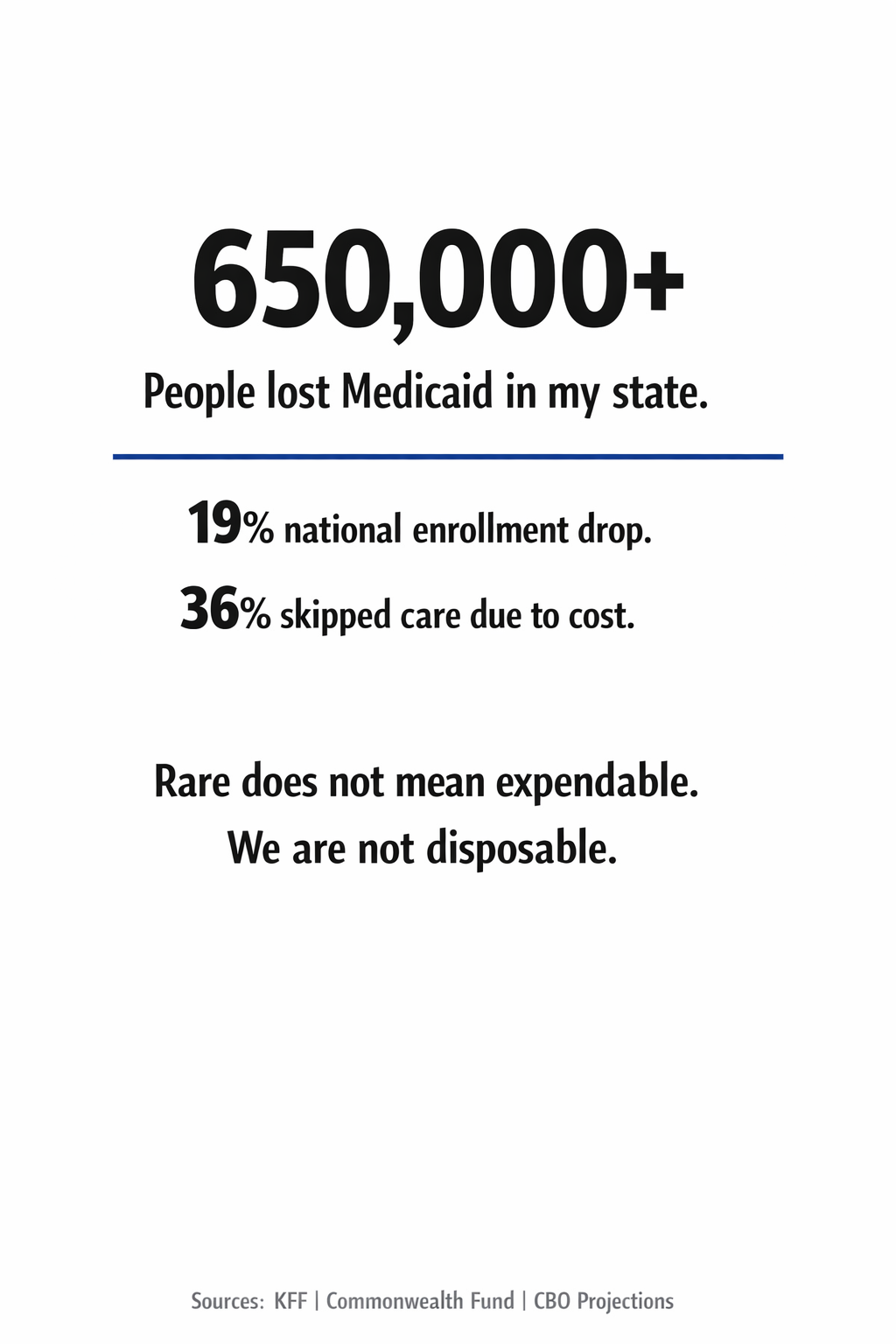
Since the COVID public health emergency ended, more than 650,000 people in my state have lost Medicaid coverage during what policymakers call “unwinding.” Nationally, enrollment dropped 19% between March 2023 and January 2026. At the same time, 36% of U.S. adults report skipping or postponing care due to cost.
I am one of the people removed.
Not because I exceeded income limits. I earn under $10,000 a year. Not because my disability disappeared. I have 20 years of documented neurological records confirming dystonia — now compounded by long COVID.
Instead of spending Rare Disease Month writing and building the small business I created knowing institutional support would never save me, I spent it fighting bureaucracy. Denials. Paperwork. Conflicting information. Endless holds. Required to prove disability yet again — while sick.
This is not fraud reduction. It is administrative attrition.
Rare does not mean expendable.
We are not disposable.
Since the COVID public health emergency ended, more than 650,000 people in my state alone have lost Medicaid coverage. Nationally, Medicaid and CHIP enrollment dropped 19% between March 2023 and January 2026. Roughly three in ten U.S. adults struggled to pay for health care in the past year, and 36% skipped or postponed care because of cost.
And projected cuts of more than $900 billion from Medicaid — part of over $1 trillion in health program reductions — are expected to push tens of millions off coverage by 2034.
I am one of them.
Not because I make too much money. I make under $10,000 a year.
Not because I suddenly became healthy. I have documented neurological disability spanning 20 years. Specialists. Records. Confirmation. Paper trails thick enough to choke a system.
I was removed during Medicaid “unwinding.”
Denied renewal.
Buried in paperwork.
Required to prove disability for the umpteenth time.
Given impossible documentation deadlines.
Given conflicting information by multiple agents.
Cut off after hours on hold.
Pressed “3” for callbacks that never came.
Left messages that were never returned.
While sick.
While managing dystonic storms, adrenal instability, long COVID flares, sleep loss, and missed treatments.
While rationing medication.
While losing work time — time that could have generated income and helped other people.
What was intended to be a month of writing during Rare Disease Month became a month of bureaucratic combat.
And this isn’t new.
I spent nearly two years fighting the State Teachers Retirement System in my state — repeatedly denied. All while board members were being removed by a court for “deceptive and disruptive” conduct fundamentally incompatible with their duty to protect educators’ financial security.
Despite public outcry, $8.5 million in performance bonuses was earmarked for fiscal year 2024, with individual staff packages increasing by $50,000 to $300,000 annually in previous years.
Meanwhile, retirees received a total of only 4% in cost-of-living adjustments since 2017, when they had expected 3% annually — leaving them roughly 20% behind projected benefit levels.
And their “disinterested physicians” routinely overruled the diagnoses of actual treating doctors.
After nearly three years of fighting, I was forced into SSDI qualification in January 2026 — another maze. Another proving ground.
All while headlines and political theater made a spectacle of “cutting waste.” I can’t help but picture Elon Musk on stage with his chainsaw — and the cheers that followed. Many of us knew exactly who would be under that blade.
Not fraudsters.
Not billionaires.
Not the healthy and insulated.
The chronically ill.
The disabled.
The rare disease community.
Survival of the fittest, baby.
Except here’s the part they miscalculated:
We are already fighting to survive every single day inside our own bodies.
You cannot bureaucratically exhaust people who have endured neurological storms.
You cannot intimidate people who have faced near-death on living room floors.
You cannot shame people who have spent two decades proving dystonia is real, debilitating, and life-altering.
What enrages me most is not the paperwork.
It is the implication.
That we are expendable.
That we are line items.
That we are “cost centers.”
That rare means irrelevant.
No.
Rare means resilient.
Rare means navigating systems designed without us in mind.
Rare means building small businesses because we know institutional support will not save us.
Rare means bending but not breaking.
Yes, I am angry.
But anger is energy.
And I am using it.
I refuse to let systemic administrative purging or political posturing determine my destiny. I refuse to let corruption shrink my calling. I refuse to let broken systems define my worth.
This is Rare Disease Month.
So here is the truth:
We are not disposable.
Not in my state.
Not in this country.
Not in this community.
If you are healthy and wealthy, understand this: the system you cheerfully dismantle today may be the one you rely on tomorrow.
If you are navigating this fight while sick, hear me clearly: you are not weak. The system is heavy. That is different.
And if you have the strength right now — advocate.
Share these stories.
Contact your representatives.
Ask hard questions.
Demand transparency.
Pay attention to where funds go and who benefits.
Do not let rare disease families fight in silence.
Because survival of the fittest is not healthcare policy.
And we are not disposable.
When the Strong One Breaks: Trusting God in the Calling No One Understands
In October 2023, I collapsed during a dystonic storm and adrenal crisis while my 80-year-old mother — my caregiver — watched helplessly. She had accompanied me to work because my long COVID and dystonia made it unsafe for me to be alone. Moments before I fell, she quietly cleaned the mess around me. That is what caregivers do — they steady chaos before anyone else sees it.
Living with rare conditions like dystonia and long COVID means navigating isolation, misunderstanding, and very little support. Caregivers carry the weight of that reality every day.
This tribute honors the quiet endurance of caregivers — the ones who show up without guarantees, who rock silently when fear hits, and who keep going when no one understands the calling they carry. My mother is one of them.
When the Strong One Breaks: Trusting God in the Calling No One Understands
In October of 2023, I collapsed on the floor of a home and pet care job my mother had accompanied me to because I was too ill to be alone.
It wasn’t dramatic in the cinematic sense. There was no slow-motion fall. Just a body that had reached its threshold.
Adrenal crisis collided with dystonic storm. Muscles contorted. Vomiting came without warning. The world narrowed to sound and light and pressure.
Then the floor.
I remember the texture of the carpet against my face. I remember the weight of my limbs refusing command. I remember the strange, almost clinical awareness that sometimes comes when your body is in extremis.
And I remember my mother.
Eighty years old.
On the sofa.
Rocking.
She had already cleaned the vomit from around me. That’s what caregivers do. They manage the mess first. They protect dignity. They act.
But now she was still. Silent.
That silence terrified me.
My mother has always been steady. Raised in a culture that honors the almighty dollar, measurable progress, visible proof. Work hard. Stay calm. Don’t make waves. Don’t collapse in public. Optimism through endurance — even if it means avoiding deeper confrontation.
She believes in “Show me and I’ll trust you.”
She has lived that way.
And in that moment, watching her daughter convulse on a stranger’s floor, she had nothing to show.
No control.
No strategy.
No visible solution.
Just fear.
There is a moment in prolonged illness where you are simply tired.
Not emotionally dramatic. Just tired.
Tired of fighting for credibility with rare conditions like dystonia and long COVID that most people either misunderstand or dismiss.
Tired of navigating a system with little-to-no support.
Tired of well-meaning advice that sounds like surrender.
“You need to accept this.”
“Maybe you’re pushing too hard.”
“Stop working.”
“Lower your expectations.”
“Be realistic.”
After witnessing that collapse, my mother insisted I halt home and pet care work. I did for a short while. And yet here we are, two and a half years later, still navigating terrain that feels unstable and largely unsupported.
That day on the floor, I could have let go.
There is a pull when your body is shutting down. A softness. A drifting.
Instead, something else happened.
Light — not metaphorical. Not theatrical. Real in a way that bypassed explanation. Orbs of clarity. Energy that felt both within me and beyond me. A comfort that steadied my spirit even as my body convulsed.
Was it a vision? A near-death phenomenon? A neurological event? A spiritual encounter?
Yes.
It was all of it.
But more than the experience itself was the decision inside it.
I did not ask, “God, show me this won’t kill me.”
I asked, “If You’re not done with me, I trust You.”
That distinction changes everything.
My mother’s posture in that moment exposed a generational fault line.
She needed proof before peace.
I needed peace before proof.
For most of my life, I gave blind loyalty to people who did not earn it. I trusted human systems. Honored approval. Stayed faithful to unfaithful structures. I confused trust with naivety.
In August 2020, I committed to recovery — not just physically, but spiritually and emotionally. Recovery from patterns that held me back. Recovery from misplaced trust. Recovery from needing validation from voices that were never called to direct my life.
That collapse was another layer of recovery.
A stripping of control.
Caregivers live at this intersection.
You are told to be practical. To be financially cautious. To manage expectations. To prepare for worst-case scenarios. To listen to experts, relatives, statistics, prognoses.
And you should use wisdom.
But wisdom without faith becomes fear disguised as responsibility.
There is a difference between being informed and being governed by human opinion.
Caregiving is not simply tending to a body.
It is guarding a calling.
And calling does not always make financial sense.
Calling does not always look stable.
Calling rarely comes with applause.
Sometimes it comes with rocking on a sofa while your child convulses on a stranger’s floor.
Sometimes it comes with silence because faith feels fragile.
Sometimes it comes with watching the strong one break.
My mother’s silence that day exposed something painful: even the steady ones can fracture when outcomes are not guaranteed.
But my clarity on the floor exposed something stronger: trust does not require guarantees.
The phrase says:
“Show me and I’ll trust you.”
“Trust Me and I’ll show you.”
Caregivers, this is not a cute reversal of words.
It is the dividing line between anxiety and obedience.
If you wait until the prognosis improves, you will never trust.
If you wait until the money stabilizes, you will never step forward.
If you wait until others understand your condition, you will stay small.
Trust does not deny reality.
Trust anchors inside it.
Rare illness is lonely. Caregiving is isolating. And when there is little-to-no external support, it is tempting to measure success by visible improvement.
But sometimes the miracle is not the healing.
Sometimes the miracle is endurance.
Sometimes the miracle is that you did not let go.
Two and a half years later, we are still navigating rough terrain. My body is unpredictable. Support is thin. Understanding is scarce.
But I am still here.
And so is she.
Not because outcomes were shown first.
But because trust was chosen first.
Caregivers, listen carefully:
You will be told to halt. To shrink. To surrender your calling to caution.
Use wisdom. But do not confuse fear with prudence.
If God has placed a calling in you — whether to build, to serve, to endure, to advocate, to create — do not demand proof before obedience.
Trust Him above the noise.
Trust Him above the statistics.
Trust Him above cultural worship of security.
Trust Him even when the strong one in your life rocks silently on the sofa.
Especially then.
Because sometimes the showing only comes after you refuse to let the floor be the end of your story.
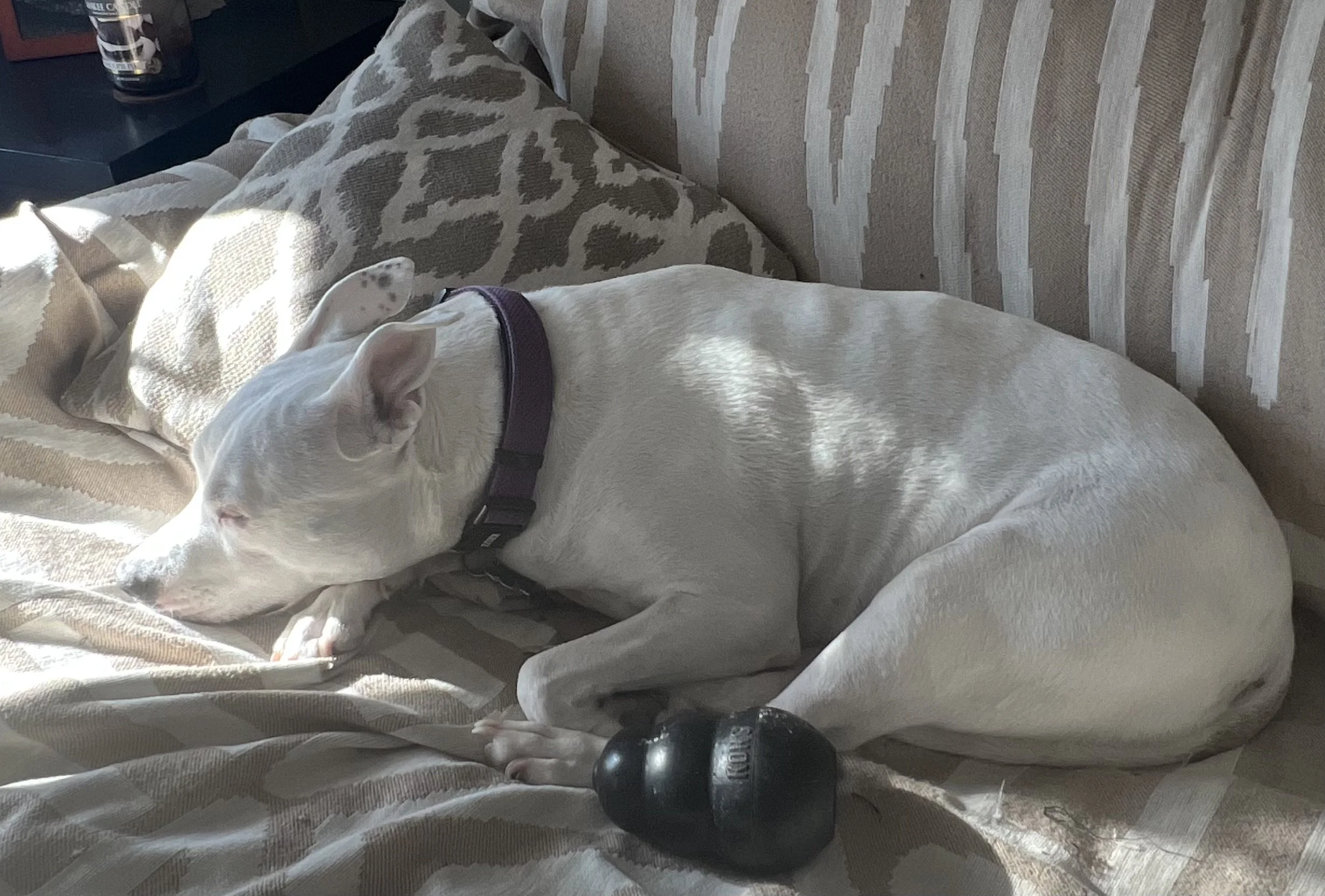
The Chrysalis
Is what I’m doing in this moment adding to the vision I have for my life—or quietly pulling me away from it?
It’s Thursday morning in Elyria. January cold—the kind that settles into your bones and makes the world feel brittle. I’m at a job caring for two of the sweetest fur babies, both rescues. Billy, black and white, tilts his head the way dogs do when he hears his name, as if language itself is a gift worth savoring. Sophie barely opens her eyes from her couch-side siesta, just enough to acknowledge she’s heard her name, just enough to stay connected without leaving rest behind.
There is something holy in that kind of presence.
I’m grateful this morning that my uncle picked my 82-year-old mother up so she wouldn’t have to drive to his home in Brecksville—forty minutes away—in her ancient car on icy highways in these freezing temperatures. Gratitude doesn’t erase the anxiety she’s been carrying: about finances, about yet another disability denial, about the long string of hardships that arrived without invitation, training, or consent. Hardships that were simply thrust into her life when illness entered mine.
Caregiving is rarely chosen the way we like to pretend it is.
Often, it’s assigned.
She’s been anxious about the cold snap.
Anxious about the state of the world.
Anxious about what tomorrow might demand.
And I find myself wishing—quietly, lovingly—that she shared my deeply ingrained core of spiritual faith. Not because faith erases anxiety (it doesn’t), but because it gives anxiety somewhere to rest. We’ll unpack that more another day. For now, the truth can stand on its own.
One of the most consistent undercurrents of my life has been the fear of losing those who matter most to me. Sometimes that loss has been literal—death, relocation, job loss, estrangement, separation. In the world of rare disease, it is often the loss of life as we once knew it: the sudden, ruthless pulling of the rug out from underneath everything we had cautiously and purposefully built. Sometimes the loss takes the form of anticipatory grief—the constant bracing for impact, the quiet calculation of what might be taken next. Most often, it is both at once. A wound and a calling, intertwined so tightly I can no longer tell where one ends and the other begins.
Maybe that’s the lesson I’m meant to learn in this lifetime.
Maybe it isn’t.
We don’t get to decide what the universe—or God—assigns to anyone else’s journey.
What we do get to decide is how we show up inside the one we’ve been given.
We can choose the gifts.
We can practice gratitude.
We can look for the opportunities and lessons hidden inside moments that don’t look like blessings at all.
And then we can work—really, really hard—to pay it forward.
The beloved badass of Yellowstone, Beth Dutton, says it more colorfully. And honestly, sometimes language like that fits.
We try.
We fail.
We try again.
We fail better.
Learn better.
And do better.
We don’t do it perfectly, and we don’t do it just for ourselves.
We do it for the children.
For their children.
For future generations of this beautiful planet we’ve been entrusted with.
There are very few people—if any—whose lives have turned out exactly as they imagined.
That was never the point of the journey.
This is why the caterpillar has always felt like such a faithful metaphor for being human.
Scientifically speaking, a caterpillar’s life unfolds in stages that mirror our own more closely than we like to admit. There’s the egg, then the larval stage—an intense season of eating, growing, developing. In human terms, we might call this childhood. Then come the instars: growth phases marked by molting, by shedding skin that no longer fits. These stages parallel adolescence, which has changed drastically over time. What once ended in the early teens now stretches well into the late twenties for many of us.
During these years, caterpillars grow and shed repeatedly.
So do we.
The skin splits.
Growth demands discomfort.
But the stage I’m most drawn to—the one we talk about least—is the chrysalis.
Once fully grown, the caterpillar forms a chrysalis (or a cocoon, in the case of moths). Inside it, the body doesn’t simply rest. It breaks down. Cells dissolve and reorganize entirely. The creature becomes something unrecognizable before it becomes something new.
In human terms, the chrysalis is isolation.
It is darkness.
It is solitude.
It is quiet.
Sometimes it’s chosen.
Sometimes it’s imposed.
Often, it’s both.
If we fight that stage—if we demand productivity, visibility, or proof of worth while we’re still dissolving—we don’t emerge well. We risk never emerging at all. But if we rest within it, if we listen, if we discern what this season is asking of us, something extraordinary happens.
We don’t just pop out one day and fly.
Emergence is a process.
The chrysalis falls away slowly, and that shedding often mirrors what happens with our families of origin. Differentiation hurts. Separation costs. Becoming who we are meant to be sometimes requires distance we never planned to take. I can be honest about that without being cruel. I can acknowledge fracture without denying love. The emotional cost is real—and so is the necessity.
As inhabitants of this planet, we all have a responsibility. I believe we pay rent here not with perfection, but with intention—by choosing, moment by moment, to do the next right thing.
I’ve learned to ask myself, with uncomfortable honesty:
Is what I’m doing in this moment adding to the vision I have for my life—or quietly pulling me away from it?
As a person of faith, I understand this as living in alignment with God’s teachings, or at least striving toward them. Others may frame it differently. What matters is the shared truth underneath: the next moment is not guaranteed.
So how I spend this one matters.
I live under the authority of something greater than myself—a power fueled by love, trust, connection, and mission. When I forget that, anxiety tightens its grip. When I remember it, fear doesn’t disappear, but I become steadier within it.
If there is comfort here, let it be this: the quiet seasons are not wasted.
The fear does not mean failure.
The chrysalis is not the end of the story.
And if there is a challenge, let it be this: stop rushing your own becoming to make others comfortable.
Choose meaning anyway.
Choose purpose anyway.
Choose love, even when it costs.
Rest when it is time to rest.
Emerge when it is time to emerge.
I am not meant to fly all the time.
But when I do, may it be with wings formed by truth, patience, and grace.
Author’s Note
This essay was written in a season of quiet becoming—shaped by caregiving, chronic illness, faith, and the slow, often unseen work of transformation. It is not meant to offer answers so much as companionship, language for experiences that are often lived but rarely named. If you find yourself in a chrysalis season—waiting, grieving, listening, or learning to trust again—may this piece remind you that rest is not failure, and becoming is not wasted time.