
The Last Living Piece
What a little black cat taught my mother and me about grief, generations, and staying in the conversation
by SherriAnne Leslie
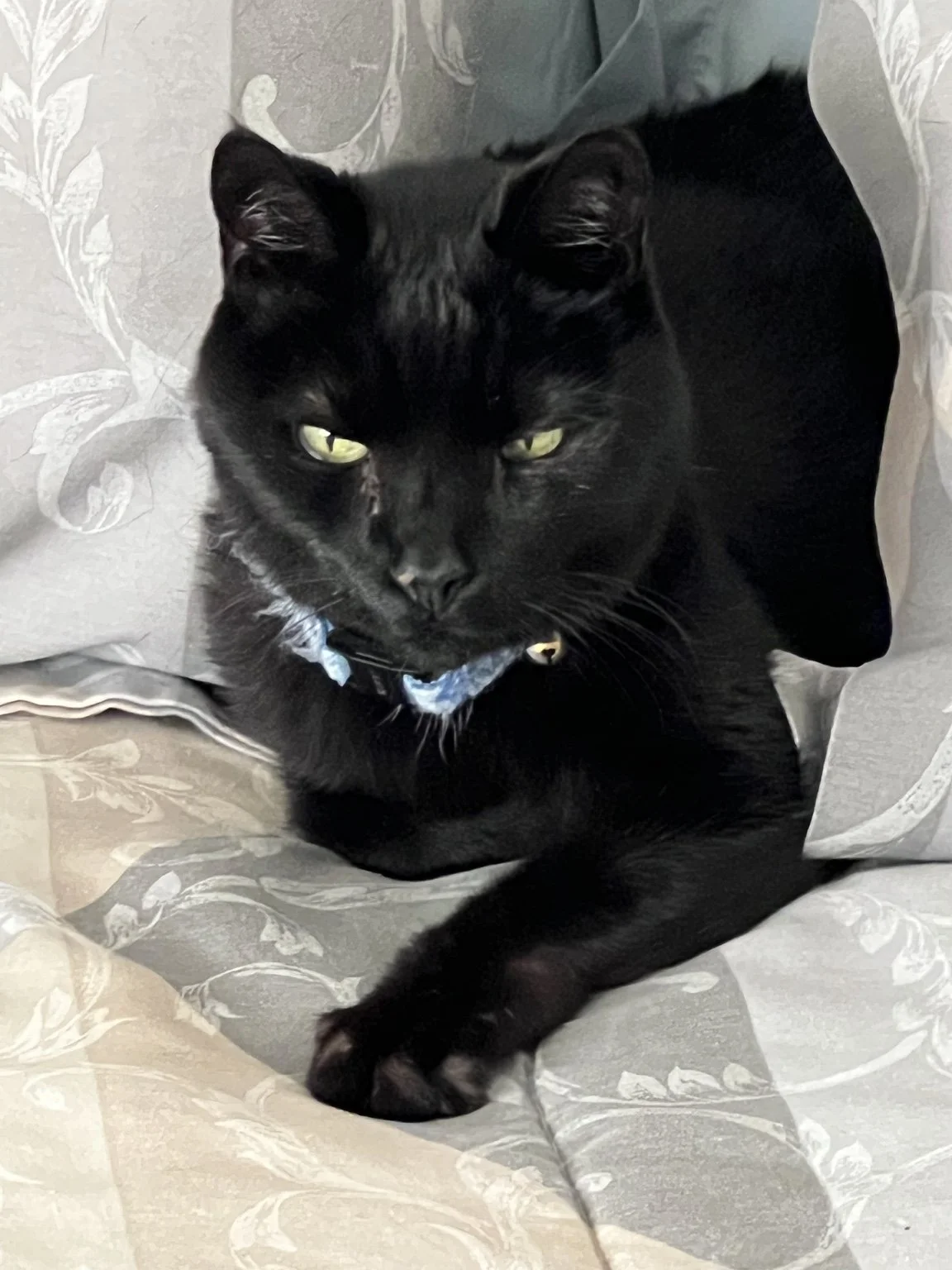
“Dude” to my mom. Fourteen years of family history in one little black cat.
When my son was three years old, I spent a lot of mornings lying on the couch with him.
It was 1996. I was pregnant with my eldest daughter and on bed rest, as I had been with my high-risk pregnancies. My little boy loved The Lion King, so we watched it endlessly—the way only a three-year-old can watch the same movie over and over and still believe this viewing is absolutely necessary.
Sometimes I watched with him. Sometimes I fell asleep.
All these years later, the opening still gets me. Elton John. "Circle of Life."
I understood even then that those mornings were precious. I savored them. What I couldn't yet understand was how differently the people I loved might be experiencing the very same moments—and how quickly the circle would turn.
A Halloween Kitten
In October 2012, the baby I had been carrying was about to turn sixteen.
She was my Halloween baby and an animal lover. Unlike the stereotypical teenager approaching her Sweet Sixteen, she wasn't asking for a car or an elaborate party.
She wanted a little black cat. That was it.
Outside, the remnants of Hurricane Sandy were battering Northeast Ohio. High winds and power outages closed schools across the Cleveland area, some for days. My kids and I were unexpectedly home. I had planned to wait until her birthday, but circumstances—and perhaps a little maternal impatience—changed the plan.
A tiny black kitten joined our family.
Dracula.
On October 30, she introduced him online with the kind of understated announcement only a teenager could make:
"You guys, meet Dracula. (:"
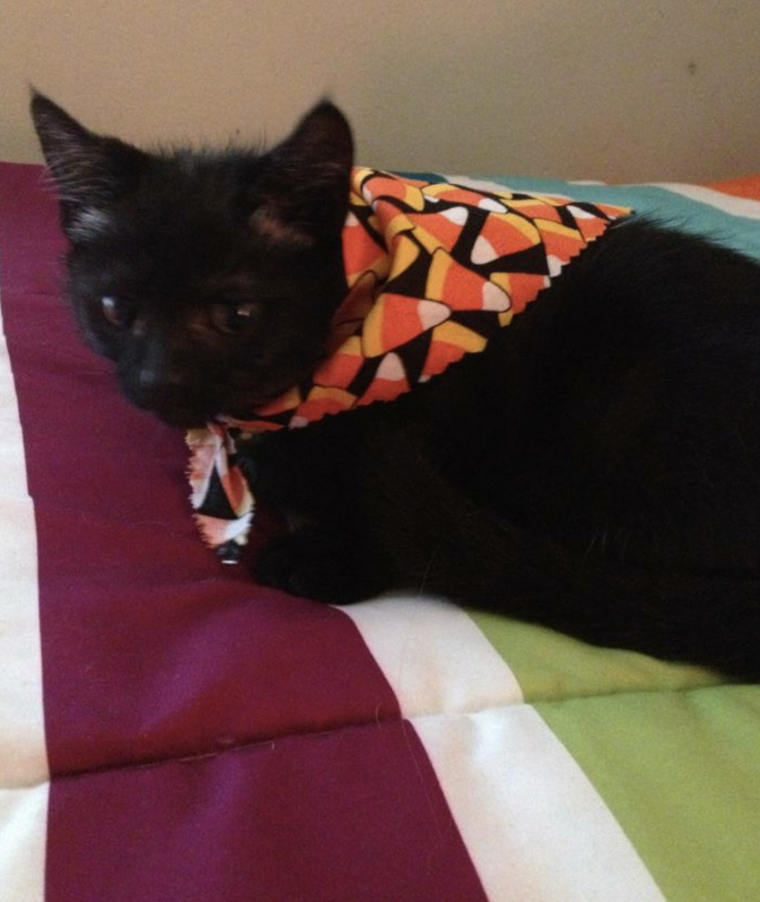
Dracula, October 2012. A little black kitten for a Halloween baby.
In the picture, the tiny black creature is wearing a candy-corn bandana.
Of course he is.
A black kitten for a Halloween baby, arriving during a hurricane. I couldn't have known everything that little cat would come to represent.
The Hurricanes Between Then and Now
There were hurricanes in our family, too. Not the meteorological kind.
There was an accident I didn't know how to handle. A divorce I didn't navigate the way I wish I had. Moves, relationships, and instability. Some of it was beyond my control.
Some of it wasn't.
I don't want to tell this story with the convenient wisdom of hindsight and claim I didn't know how precious the good moments were.
I did. I knew exactly how precious they were. I savored them.
I had poured enormous parts of my life into learning how to raise children well. I studied child development and education. I tried to practice what I understood to be best. My children weren't incidental to the life I was building; they were at the center of it.
That's what makes looking back so complicated.
While I was consciously creating and treasuring those moments, my children were sometimes carrying feelings they didn't tell me about. They were surviving our family's hurricanes, too. In ways that feel painfully familiar now, they may have contained what they felt—to protect me, to protect a peaceful moment, or simply because none of us knew what to do with all of it.
Perhaps the generational distance between my mother and me isn't as great as I'd like to believe.
Love, education, intention—even knowing many of the "right" things to do—did not make me immune to getting some very important things wrong.
Nor did I parent in a vacuum. Single mothers are expected to earn, care, organize, absorb, recover, and keep going under pressures the research documents well. That doesn't excuse my mistakes. It was simply the weather they happened in.
There are decisions I would give anything to make differently. My children lived with their consequences.
That doesn't erase the beautiful moments. It makes them more complicated.
There were children curled against me on couches. Movies watched a hundred times. Birthdays and animals and laughter and ordinary mornings. Moments when, whatever hurricane was raging around us—or inside me—I knew exactly what mattered.
My children. My family. Home.
And for fourteen years, Dracula remained.
Homes changed. Relationships changed. My children grew up, and their lives moved forward, as they were supposed to. Mine changed in ways I never could have anticipated.
But there was Dracula. Meowing. Wanting attention. Needing food. Being Dracula.
He was one of the last living pieces of that life—a daily connection to moments with my children that I cherished fiercely while we were living through hurricanes together.
Dude
My mother called him Dude. She's 83 now.
Recently, while I've been working beyond what I should to keep my business running and get employees properly in place before winter, Mom has been helping me with pet-care work. She has enjoyed it. It’s kept her active and makes her feel useful. Her last job was only about ten minutes from our apartment, so she could come home and check on Dracula. When neither of us was home last week, our neighbor friend cared for him.
Upon returning, she told us something unsettling. Dracula had tried to jump onto the counter, missed, and fallen backward, hitting the back of his head.
I don't know what role that fall ultimately played in what happened. We may never know.
But when Mom and I were both finally home Saturday night, Dracula wasn't right. He was terribly thin. By Sunday, I was very worried. I kept asking about him whenever I talked to Mom.
Monday morning, I texted her. No answer.
Eventually, I called. She'd just gotten back from Marc's. She was going to coffee. Later, she was coming over for chili.
When she arrived, she told me.
She had taken Dracula to the vet…. His lungs were filled…. He was gone.
I was devastated. And I was furious.
Why hadn’t she called me?
The veterinarian was five minutes away. I could have come home. I could have been there. I could have done something—even if that something ultimately changed nothing.
Instead, the decision had been made without my ability to say goodbye.
I was hurt. And I told her so.
What We Do With Hurt
Later, I texted my mother:
"He was the last living daily reminder of a life I cherished with my children."
As the day unfolded, I realized even that wasn't quite right. Dracula wasn't evidence of some idyllic family chapter I had lost. He was evidence that beautiful moments had existed inside the difficult ones—and that I had known they were beautiful while I was living them.
Mom responded:
"He will be with you forever. I am truly so sorry."
Then she told me something I wasn't expecting:
"Dude made me feel safe. Crazy but true."
I stopped.
This wasn't only my loss. My mother was grieving him, too. She simply wasn't grieving like me.
And there, underneath one little black cat and two devastated women, was something much older.
Generations.
My mother eventually wrote:
"I don't have a way to express my feelings."
And then:
"I was taught not to show feelings and no matter how hard I try I just can't. I carry everything inside."
There it was.
Not an excuse. An explanation. There is a difference.
My mother came from a generation in which emotional survival often meant containing things. You kept going. You didn't burden other people. You handled what needed handling and carried pain quietly, because that was what people did.
I am different. I need words. I need to understand. I need to say, You hurt me.
And, maybe even more importantly, I need the person I love to stay in the conversation after I say it.
So I told her the truth:
"I know. And I forgive you. I know it wasn't done maliciously, but that doesn't take away the hurt."
I've been thinking about that sentence ever since, because two things can be true.
I can understand why my mother did something and still be hurt by it. She can love me and make the wrong decision. I can forgive her without pretending it didn't matter. And she can explain herself without demanding that her explanation erase my pain.
Maybe this is where families so often lose one another.
Not in the original injury. In what happens next.
Stay in the Conversation
Eventually, children become old enough to look back and see the things their parents did that hurt them.
Then, if we become parents ourselves and live long enough, we gain another uncomfortable vantage point: we can see the ways we hurt our own children, too.
I certainly can. Understanding what I was going through at the time doesn't erase the consequences of my choices. Neither does loving my children beyond measure.
I loved them then. I love them now. And still, there are things I wish I'd done differently.
Perhaps that is one of adulthood's crueler gifts: we become old enough to understand our parents at the same time we become old enough to understand what our own children may someday have to forgive in us.
My mother and I could have stopped talking that morning. I was angry enough. She was hurting enough.
Instead, we kept going.
Our texts wandered through Dracula, guilt, illness, work, divorce, accidents, caregiving, regrets, and the strange ways mothers and daughters spend lifetimes worrying that they haven't done enough for one another.
At one point, Mom told me:
"I know you will always keep trying."
And then, in classic Mom fashion:
"You never were a quitter."
And somehow, after death and tears and anger and fourteen years of memories, my 83-year-old mother announced that she was going for a cool walk.
Life continued. It always does.
The Circle
That morning I lost Dracula. But I wasn't only grieving a cat.
I was grieving a sixteen-year-old Halloween baby who once wanted nothing more extravagant for her birthday than a little black kitten.
Children who aren't children anymore. Homes we once lived in. Versions of myself I sometimes miss, and versions I don't. Mistakes. Second chances. Ordinary mornings I knew were extraordinary while I was living them.
And underneath all of it, a three-year-old boy curled beside me on a couch while his pregnant mother drifted in and out of sleep as The Lion King played for what must have been the thousandth time.
The circle of life sounds poetic when you're young. At 56, it feels considerably less so.
Things begin. Things end. Children arrive and grow up. Parents age. Pets become family and leave before we're ready. We hurt people we love. People we love hurt us.
And sometimes, if we're fortunate, we get another conversation.
My mother couldn't give me back the phone call I desperately wish she had made. I couldn't give her words she was never taught to say. Neither of us could bring Dude back.
But we could keep talking. We could listen long enough to discover that underneath my anger was grief, and underneath her silence was grief, too.
Different generations. Different emotional languages.
Same little black cat. Same loss. Same love.
Maybe that's the part of the circle I'm still learning.
I've always been better at holding on than letting go. Maybe I don't need to learn how to hold on less. Maybe I need to learn that letting go doesn't mean leaving behind.
Some things we carry with us.
